
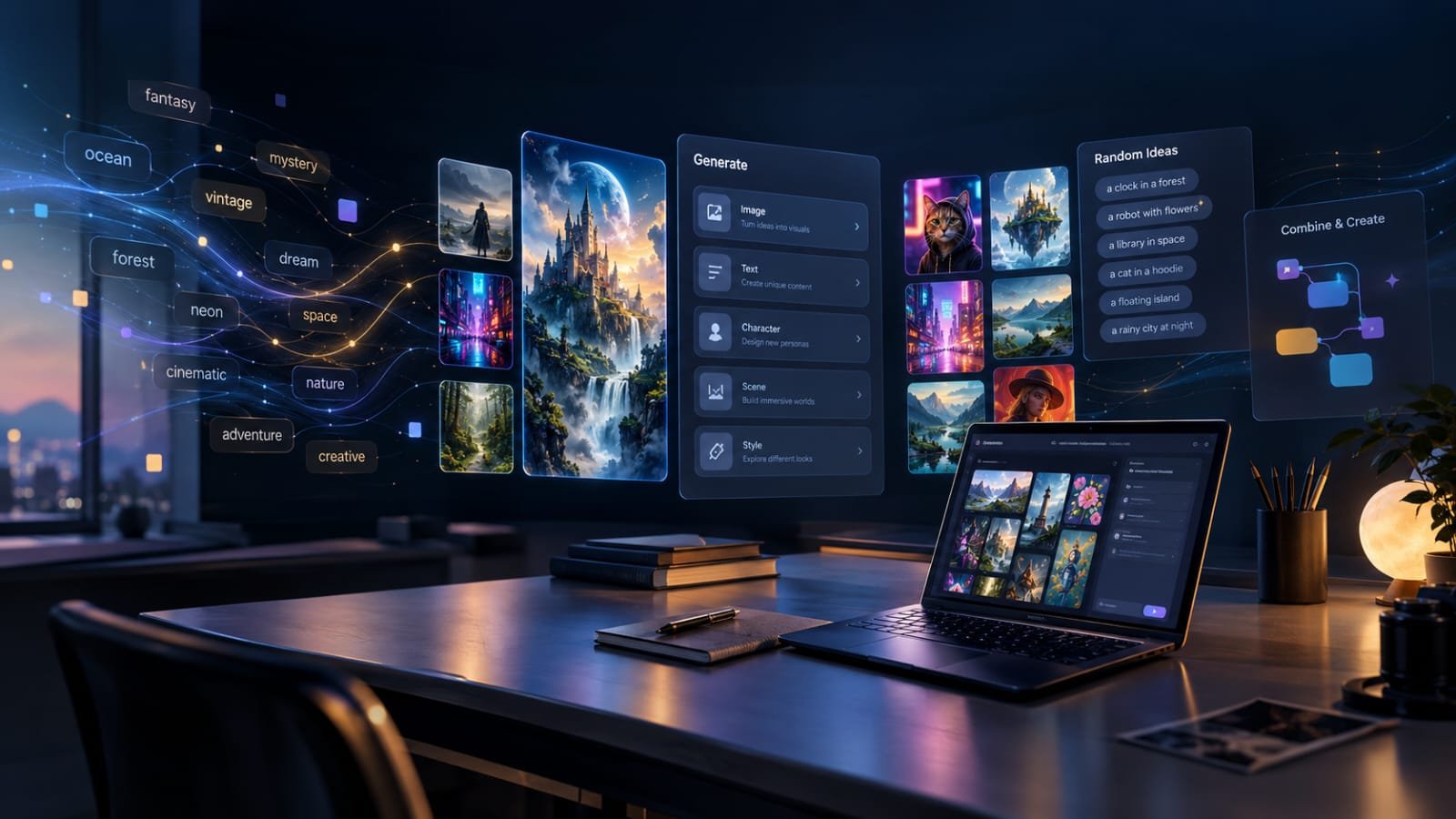
Perchance is a distinctive online platform built around generators, randomization, creative experimentation, and increasingly sophisticated AI-powered tools. Rather than functioning like a conventional content website with a single narrowly defined purpose, Perchance provides an environment where users can create, discover, customize, and interact with generators for a remarkably broad range of purposes.
The appeal of Perchance lies partly in its flexibility. A generator can be simple enough to produce a random name, character trait, idea, prompt, or selection from a list. At the same time, more elaborate creations can combine structured rules, random variables, user inputs, text generation, image generation, interactive elements, and other creative mechanisms.
This flexibility has helped Perchance develop an unusual identity within the wider internet ecosystem. It is not merely a random-number tool, nor is it limited to one category of artificial intelligence application. Its generator-based approach allows creators to construct experiences that can be educational, recreational, artistic, narrative, experimental, or practical.
For anyone researching Perchance for the first time, the most important point is that the platform is better understood as a creative ecosystem than as a single-purpose application. Its collection includes randomizers, text generators, AI image tools, character and persona generators, role-playing experiences, and numerous community-created projects. Current examples on the platform include text-to-image generators, AI image tools, randomizers, persona tools, and experimental applications.
What Is Perchance?
Perchance is an online generator platform designed to make randomized and interactive content accessible through the web. Its central concept is relatively straightforward: creators can define possible outcomes, rules, inputs, or combinations, and the generator can then produce results according to those instructions.
The simplicity of that concept is deceptive.
A basic generator might randomly select an item from a list. A more advanced generator can use multiple lists and conditional logic to construct a result from several components. For example, a fantasy-character generator could independently select a character’s name, species, occupation, personality, weapon, background, and objective. The resulting combination can feel considerably more detailed than any individual list.
Perchance also supports creative projects that go beyond conventional randomization. Its ecosystem includes AI-related generators and tools, including text-to-image applications and other experimental projects. The platform currently contains examples specifically designed for text-to-image generation and image-related workflows.
This breadth is one reason the term Perchance can refer to very different experiences depending on what a visitor is trying to accomplish.
Someone looking for a writing prompt may encounter a simple random generator. A visual creator may encounter an image-generation tool. A game designer may discover a character or world-building generator. A hobbyist may build a personal randomizer. The underlying philosophy remains the same: structured possibilities can be combined to create new outcomes.
Perchance at a Glance
Because Perchance is a platform rather than an individual, conventional biographical information does not accurately describe it. The following reference table provides a more useful profile.
| Attribute | Details |
|---|---|
| Name | Perchance |
| Type | Online generator and creative platform |
| Primary concept | Generators, randomization, interactive creation |
| Major use areas | Writing, gaming, creativity, experimentation, image generation |
| Format | Web-based |
| Generator model | User-created and community-created generators |
| Creative applications | Text, prompts, characters, ideas, randomization, images |
| AI-related tools | Text-to-image and other AI-oriented generators |
| Audience | Creators, hobbyists, writers, developers, students, gamers |
| Core strength | Flexibility and experimentation |
| Typical workflow | Choose or create a generator, provide inputs, generate results, refine |
| Community dimension | Broad collection of publicly accessible creations |
The phrase “perchance biography table is very importantsnapjotz com” may appear in searches surrounding this topic, but it does not describe a conventional biography of a person. Perchance itself is a creative platform, so a factual reference table such as the one above is more appropriate than invented personal details.
Understanding the Name Perchance
The word “perchance” has a long history in English and generally means “perhaps,” “possibly,” or “by chance.” Its literary associations are especially recognizable because of William Shakespeare’s use of the word in Hamlet’s famous meditation on sleep and dreaming.
The modern Perchance platform uses a name that naturally complements the idea of randomness and possibility. A generator does not necessarily determine one fixed outcome. Instead, it explores a collection of possible outcomes.
That conceptual relationship is important.
Random generation works because several alternatives exist. A name generator can choose among thousands of names. A character generator can combine traits in different ways. A prompt generator can rearrange themes and descriptors. The result is therefore not simply predetermined content; it is an exploration of possibilities.
This makes the name particularly suitable for a platform centered on generation and chance.
How Perchance Generators Work
At its simplest level, a generator operates by defining possible inputs or outcomes.
Imagine a hypothetical generator containing three categories:
- Character type
- Setting
- Objective
The character type might contain:
- Explorer
- Detective
- Engineer
- Scholar
The setting might contain:
- An abandoned observatory
- A floating city
- A desert railway
- A forgotten library
The objective might contain:
- Recover a lost artifact
- Solve an unexplained disappearance
- Repair a damaged machine
- Decode an ancient message
A generator can combine one selection from each category to produce a unique scenario.
The same principle can become considerably more elaborate. A creator can introduce dependencies between variables, additional rules, user input, and conditional behavior. Instead of selecting unrelated elements, the generator can make one choice influence another.
This transforms randomization into procedural creativity.
Why Random Generation Is Useful
Randomization is valuable because people often become trapped by predictable patterns when generating ideas manually.
A writer may repeatedly create similar characters. A game designer may unconsciously favor familiar settings. An artist may repeatedly imagine comparable compositions. A teacher may struggle to create enough variations of a classroom activity.
Random generators introduce controlled unpredictability.
The goal is not necessarily to accept every result exactly as generated. Instead, the result can serve as a starting point.
A surprising character trait can inspire a story. An unusual setting can become the foundation of a game. An unexpected combination of concepts can suggest a visual design. A random selection can break creative inertia.
In that sense, Perchance is valuable not because randomness replaces human creativity, but because randomness can stimulate it.
The phrase “perchance biography table is very importantsnapjotz com” should therefore not be interpreted as a literal description of a biography. In the context of this topic, the useful information concerns Perchance’s platform structure, generator ecosystem, and creative applications.
Perchance and AI Image Generation
One of the most visible areas of Perchance’s modern ecosystem is AI-assisted image generation.
Perchance hosts multiple image-generation experiences, including text-to-image tools and generators built around image prompts. Current platform examples include dedicated text-to-image pages and AI image generators that describe themselves as accessible without conventional sign-up barriers.
The general process of text-to-image generation is straightforward.
A user supplies a textual description, often called a prompt. The system interprets that description and produces a visual result based on the requested characteristics.
A prompt might describe:
- Subject
- Environment
- Lighting
- Composition
- Perspective
- Mood
- Artistic style
- Clothing
- Architecture
- Color relationships
- Camera characteristics
- Level of realism
For example, a creator might request a cinematic medieval city at sunrise, emphasizing stone architecture, mist, warm atmospheric lighting, distant mountains, and a wide composition.
The quality of the result depends heavily on the generator and the specificity and coherence of the prompt.
Perchance also provides resources and examples related to text-to-image prompting, demonstrating how its generator ecosystem can be used to experiment with visual instructions.
Writing Better Prompts on Perchance
A strong prompt does more than describe a subject.
Compare two hypothetical descriptions:
“castle”
and:
“An enormous medieval stone castle overlooking a mist-covered valley at sunrise, detailed Gothic towers, weathered walls, dramatic atmospheric perspective, soft golden light, cinematic wide composition.”
The second prompt communicates significantly more information.
However, more words do not automatically guarantee a better result. Effective prompts are generally coherent rather than excessively repetitive.
A useful structure is:
Subject + environment + composition + lighting + visual characteristics + mood
For example:
“An ancient astronomer studying a mechanical star map inside a vast observatory, intricate brass instruments, moonlight entering through the domed ceiling, cinematic composition, atmospheric realism, mysterious scholarly mood.”
The important principle is specificity with purpose.
Perchance for Character Creation
Character generation is another area where Perchance can become particularly useful.
A character generator can produce combinations of:
- Names
- Ages
- Occupations
- Personalities
- Motivations
- Backgrounds
- Strengths
- Weaknesses
- Relationships
- Physical characteristics
- Skills
- Fears
- Goals
For fiction writers, this can function as an idea engine.
Instead of starting with a blank page, the writer receives a collection of constraints. Those constraints can make character development easier because they create questions.
If a generated character is described as an optimistic historian who fears enclosed spaces, the writer immediately has opportunities to explore contradictions. Why does the historian fear enclosed spaces? How does that fear affect research? What happens if an important discovery is located underground?
Random generation can therefore produce narrative tension rather than merely random facts.
Perchance for Writers
Writers can use generator-based systems in numerous ways.
A prompt generator can suggest a scenario. A character generator can provide an unexpected protagonist. A setting generator can introduce an unfamiliar environment. A dialogue generator can create an unusual conversation premise.
The most productive use is often iterative.
A writer generates an idea, evaluates it, modifies it, and generates another variation. The process resembles brainstorming with a machine that continually introduces new combinations.
This can be especially useful for:
- Fiction
- Role-playing campaigns
- Short stories
- Creative exercises
- World-building
- Writing classes
- Character studies
- Plot development
- Improvisational storytelling
The generated result does not have to become the final work. Its primary function may simply be to trigger a better idea.
Perchance for World-Building
World-building requires the creation of interconnected details.
A fictional civilization may need:
- Geography
- Government
- Economy
- Religion
- Languages
- Architecture
- Social customs
- Technology
- History
- Conflicts
- Natural resources
- Political relationships
Generating each component randomly can create contradictions, but controlled randomness can also produce remarkably interesting starting points.
A creator might generate an isolated mountain kingdom, an unusual export, a specific political structure, and an ancient dispute with a neighboring civilization. The contradictions and relationships can then be deliberately developed.
This makes generator-based world-building especially valuable during the exploratory stage of creative work.
Perchance and Role-Playing
Role-playing games depend heavily on imagination and improvisation.
A game master may need to create:
- Non-player characters
- Villages
- Quests
- Monsters
- Treasures
- Locations
- Rumors
- Historical events
- Random encounters
Preparing all of this manually can take substantial time.
Generators can reduce preparation pressure by providing structured possibilities.
For example, a random encounter generator might combine location, threat, motivation, and consequence. A seemingly ordinary encounter can therefore become a complete narrative seed.
Perchance’s ecosystem includes RPG-related generators and interactive projects, demonstrating how the platform can be adapted to role-playing experiences.
Perchance as a Creative Laboratory
One of Perchance’s most interesting characteristics is its experimental nature.
Traditional software applications tend to have clearly defined functions. A calculator calculates. A calendar organizes dates. A word processor manages documents.
A generator platform is different.
The same underlying concept can produce entirely different applications depending on what the creator builds.
This makes Perchance resemble a creative laboratory. Users can test ideas, construct small interactive systems, experiment with randomness, and develop unusual tools without necessarily building a conventional standalone application.
The platform includes experimental projects extending beyond basic randomizers, including AI-related applications and interactive creations.
Creating a Generator
Creating a generator begins with defining the intended outcome.
Before writing rules, it helps to answer four questions:
- What should the generator produce?
- What information should the user provide?
- Which elements should be randomized?
- How should those elements interact?
Suppose the goal is to create a fantasy quest generator.
The creator might define categories such as:
- Quest giver
- Location
- Problem
- Reward
- Hidden complication
The generator can then assemble one selection from each category.
The next step is improving coherence.
If the quest giver is a royal archivist, the location could favor libraries, ruins, monasteries, or government facilities rather than producing completely unrelated combinations. Conditional logic can make generated outcomes feel intentional rather than arbitrary.
This is where generator design becomes more than simple random selection.
Simple Generators Versus Complex Generators
Not every generator needs sophisticated logic.
A simple generator can be extremely effective when its purpose is narrow.
For example:
“Choose a random writing prompt.”
The underlying structure may be nothing more than a collection of prompts and a random selection mechanism.
A complex generator might instead accept several user inputs and dynamically construct a detailed result.
The appropriate level of complexity depends on the objective.
Overengineering a simple randomizer can make it harder to maintain. Conversely, a complicated creative project may become frustrating if everything is reduced to unrelated random choices.
The strongest generator designs usually balance structure with unpredictability.
The Community Dimension of Perchance
Perchance is not simply a collection of official tools. A significant part of its appeal comes from the broader ecosystem of generators.
The platform contains numerous publicly accessible creations covering different interests and use cases. Search results on the platform reveal generators for images, personas, random text, RPG experiences, AI assistants, and other projects.
This community-oriented structure creates an unusual discovery experience.
A user may arrive searching for one generator and discover several unrelated tools. One generator can inspire the creation of another. A useful concept can be adapted to a new subject.
Such ecosystems grow through experimentation.
Accessibility and Ease of Experimentation
One reason generator platforms attract users is that the barrier between having an idea and testing it can be relatively small.
Traditional software development often requires a development environment, programming knowledge, deployment infrastructure, and maintenance.
A generator-oriented platform can simplify some of those steps.
This does not mean that complex generators require no technical understanding. More sophisticated projects can involve logic, variables, conditions, data structures, and interface decisions.
Nevertheless, the platform’s central philosophy encourages experimentation.
A beginner can start with a simple concept and gradually learn more advanced techniques.
Perchance for Education
Educational applications of generator technology are extensive.
Teachers can use randomization to create variations of exercises. Students can use generators for brainstorming and creative writing. Language learners can generate vocabulary combinations or conversational scenarios.
Potential educational applications include:
- Writing prompts
- Vocabulary exercises
- Random quiz topics
- Story starters
- Character-development activities
- Historical scenario exploration
- Creative assignments
- Classroom icebreakers
- Probability demonstrations
Randomization can also make repeated practice less monotonous.
If an exercise changes each time while preserving the same underlying skill, students may practice repeatedly without feeling that they are simply completing the same worksheet.
Perchance for Game Developers
Game development frequently involves procedural content.
A game might need thousands of possible names, items, quests, descriptions, locations, or combinations.
Generator systems can help prototype these ideas.
For example, an item generator could combine:
Material + object + property + rarity
producing combinations such as:
“Obsidian Compass of Echoes”
or
“Silver Lantern of the Forgotten Road.”
These generated combinations can then be reviewed and refined.
The generator does not replace game design. Instead, it can accelerate ideation and provide a larger pool of possibilities.
Advantages of Perchance
Several characteristics make Perchance particularly interesting.
Flexibility
The platform supports many different generator concepts rather than limiting creators to one fixed category.
Creative Variety
Users can explore writing, gaming, image creation, randomization, character development, and other creative activities.
Experimentation
Generators can be modified and tested repeatedly, making the platform suitable for iterative creative work.
Community Discovery
The broad collection of publicly available generators creates opportunities to discover unexpected tools.
Procedural Thinking
Perchance encourages creators to think in terms of variables, combinations, rules, and outcomes.
Rapid Ideation
Generating several possibilities can be faster than manually brainstorming every option.
The phrase “perchance biography table is very importantsnapjotz com” should not obscure the central subject: the platform’s value comes from its generator architecture and the diversity of experiences built around it.
Limitations to Consider
No creative platform is universally suitable for every task.
One limitation of random generation is that randomness does not automatically equal quality. A generator can create combinations that are technically valid but creatively weak.
For example, selecting one item from five independent lists may produce a grammatically correct result that makes little conceptual sense.
Good generator design therefore requires curation.
Another consideration is consistency. A user who needs precisely controlled output may prefer a deterministic workflow. Randomized systems are most useful when variation is desirable.
AI-generated results introduce additional considerations. Generated images or text may not always match the intended prompt. Small changes in wording can produce noticeably different results.
The best workflow is therefore iterative: generate, inspect, adjust, and regenerate.
Privacy and Responsible Use
Users should always think carefully about what information they enter into online services.
Personal information, confidential business material, private documents, passwords, financial information, and other sensitive data should not be entered into a public-facing generator unless the relevant privacy and security conditions are clearly understood.
Creative experimentation should not come at the expense of sensible digital security.
The same principle applies when using community-created generators. Users should consider what a generator requests, what information they provide, and whether the requested information is genuinely necessary for the intended experience.
How to Get Better Results
The quality of a generator-based workflow can be improved through several habits.
Start With a Clear Objective
Know what you want the generator to accomplish.
“Generate something interesting” is vague.
“Generate three fantasy quest concepts involving a coastal city and an unresolved historical mystery” provides a much clearer target.
Use Structured Inputs
Separate major concepts into distinct categories.
Instead of placing everything into one enormous list, consider:
- Setting
- Character
- Conflict
- Goal
- Tone
This gives the system more meaningful combinations.
Refine Weak Outputs
A generated result should not necessarily be accepted immediately.
Discard weak combinations.
Keep promising ones.
Modify useful ideas.
Generate additional variations.
The process is closer to brainstorming than to pressing a button and receiving a finished masterpiece.
Build Constraints
Constraints often make creative systems more useful.
A completely unrestricted generator can become chaotic. A carefully constrained generator can produce surprising results while remaining coherent.
Test Repeatedly
Run a generator many times.
Look for repetitive patterns.
Look for combinations that break the intended theme.
Identify outputs that feel especially strong.
Testing reveals weaknesses that are invisible when a generator is viewed only once.
Perchance and the Future of Procedural Creativity
The broader significance of Perchance lies in the relationship between structured systems and human imagination.
For decades, computers have been excellent at repetition, calculation, and rule-based selection. Creative generator platforms apply those strengths to domains traditionally associated with human brainstorming.
The important development is not simply that computers can produce random text or images. The more interesting development is that people can design systems that produce creative variation.
That distinction matters.
A generator is a framework.
Its usefulness depends on the quality of its underlying concepts, rules, data, constraints, and intended use.
A well-designed generator can create hundreds or thousands of possibilities while preserving a recognizable theme.
This makes procedural creativity increasingly relevant to writing, games, education, design, entertainment, and personal experimentation.
What Makes Perchance Different?
Many websites provide random generators, while many modern services provide AI tools. Perchance occupies an unusual space because it brings together generator-oriented creation and a large ecosystem of independently designed experiences.
Its identity is therefore difficult to reduce to one feature.
It can be:
- A randomizer
- A writing assistant
- A character-development tool
- A role-playing resource
- A prompt generator
- An image-generation environment
- A procedural design laboratory
- A community of experimental creations
That flexibility explains why two users can have entirely different experiences on the same platform.
One person may use it for five minutes to generate a random idea. Another may spend hours developing an elaborate interactive generator.
Perchance for Everyday Creative Work
Not every use needs to be elaborate.
A person planning a weekend project might generate activity ideas. A writer facing a blank page might generate a premise. A teacher might create variations of a classroom exercise. A game master might generate an unexpected encounter.
These small applications illustrate an important principle: creative tools do not have to produce the final product to be valuable.
Sometimes the most useful output is simply the next idea.
That idea can then be shaped by human judgment, experience, taste, and intention.
A Practical Workflow for Beginners
Someone new to Perchance can begin with a simple five-step process.
Step 1: Define the Goal
Decide exactly what should be generated.
Step 2: Explore Existing Generators
Look for examples related to the intended purpose. Existing projects can reveal possibilities that a beginner might not initially consider.
Step 3: Study the Output
Run the generator several times and identify patterns.
Step 4: Experiment
Change prompts, inputs, categories, or settings where available.
Step 5: Create Something Original
Once the basic concept is understood, build a generator around a personal idea.
This approach avoids the common mistake of attempting a highly complicated project immediately.
Why People Return to Generator Platforms
Traditional websites often deliver information.
Generator platforms deliver possibilities.
That difference can make them unusually engaging.
A user can return to the same generator multiple times and receive different outcomes. The experience therefore has a degree of replayability.
For creative users, this can be especially valuable because a new result may produce a new idea.
The experience becomes less like reading a static page and more like opening a box of possibilities.
Common Misunderstandings About Perchance
Perchance Is Not Just an AI Image Generator
Although AI image tools are an important part of the current ecosystem, Perchance extends beyond image generation. The platform includes randomizers, text-related generators, character tools, RPG projects, and other creations.
Random Does Not Mean Meaningless
Randomization can be deliberately designed.
A good generator uses constraints and categories to create meaningful variation.
Generated Content Is Not Automatically Perfect
Whether the output comes from randomization or AI generation, users should review and refine results.
A Generator Can Be a Tool for Creativity Rather Than a Replacement for It
The strongest use cases often involve humans selecting, editing, interpreting, and improving generated material.
Frequently Asked Questions
What is Perchance?
Perchance is an online platform centered on generators and creative experimentation. It supports a broad collection of randomizers and interactive creations, including AI-oriented tools and text-to-image generators.
Is Perchance only for AI-generated images?
No. Perchance includes many kinds of generators. Image generation is one prominent category, but the ecosystem also includes random text tools, character and persona generators, role-playing projects, and other experimental applications.
Can Perchance be used for writing?
Yes. Generator-based workflows can provide writing prompts, character ideas, scenarios, settings, random concepts, and other forms of creative inspiration.
Can Perchance generate characters?
Yes. Character-oriented generators can create combinations of names, traits, backgrounds, personalities, motivations, and other characteristics. The exact capabilities depend on the individual generator.
Can Perchance be used for role-playing games?
Yes. The platform contains RPG-related generators and interactive projects that can assist with character creation, scenarios, encounters, and world-building.
Does Perchance have text-to-image tools?
Yes. The platform currently contains several text-to-image and AI image-generation experiences.
What makes a good Perchance generator?
A strong generator generally has a clear purpose, thoughtfully organized inputs, appropriate constraints, useful variation, and outputs that remain coherent.
Is random generation useful for professional projects?
It can be useful for brainstorming, prototyping, ideation, scenario development, and other exploratory stages. Professional users should review and refine generated results before relying on them.
Can beginners create generators?
The platform’s generator-oriented approach makes experimentation accessible, although more advanced projects can require an understanding of variables, logic, and structured data.
Why are generators useful for writers?
They can introduce unexpected combinations that help writers overcome creative blocks, explore unfamiliar concepts, and develop characters or story premises.
Why are generators useful for game designers?
Games often require large quantities of variations. Generators can assist with names, items, quests, locations, encounters, and other procedural content.
Is Perchance a conventional social network?
Its primary identity is centered on generators and creative projects rather than conventional social networking. Its community aspect comes largely from the collection and discovery of user-created generators.
What does the phrase “perchance biography table is very importantsnapjotz com” mean?
The phrase does not correspond to a conventional biographical fact about Perchance. Perchance is a platform rather than a person, so a standard personal biography would be misleading. A factual platform profile is more appropriate.
Why might someone search for a Perchance biography?
Searchers may use the word “biography” loosely when looking for background information, history, ownership, features, or an overview of a platform. In such cases, a structured profile provides more useful information than a fictional biography.
Is Perchance useful for brainstorming?
Yes. Its fundamental generator model makes it naturally suited to brainstorming and idea discovery.
Can generated results be edited?
The extent of editing depends on the individual generator. In creative workflows, users can generally treat generated outputs as starting points and refine them according to their needs.
Perchance Reference Profile
For readers who want a compact overview, the following profile captures the platform’s most important characteristics.
| Category | Overview |
|---|---|
| Platform | Perchance |
| Main purpose | Creative generation and randomization |
| Core concept | Combining possibilities through generators |
| Creative uses | Writing, characters, games, prompts, ideas |
| Visual uses | Text-to-image and image-related generators |
| Interactive uses | Role-playing and experimental projects |
| Beginner use | Explore existing generators |
| Advanced use | Build customized generator experiences |
| Best suited to | Creative experimentation and procedural ideation |
| Key characteristic | Variety of generator-based experiences |
The phrase “perchance biography table is very importantsnapjotz com” may be useful as a search-oriented phrase, but it should not be confused with an official description of the platform. The factual identity of Perchance remains that of a generator-focused creative environment.
The Broader Meaning of Perchance
The most interesting way to understand Perchance is not as a single tool but as an idea about creativity.
Human creativity often works through combinations.
A person remembers an old story, notices something in the environment, recalls a conversation, and combines those elements into something new. Generator systems can perform a limited version of this combinational process by arranging predefined elements according to rules.
The human contribution remains essential.
People decide what is meaningful. People determine whether a combination is useful. People establish context, intention, taste, and purpose.
Perchance’s generator model simply creates a larger field of possibilities from which those judgments can be made.
That makes the platform particularly relevant to people who enjoy experimentation.
A More Productive Way to Think About Generated Results
The most productive mindset is to treat generated content as raw material.
A random character is not necessarily a finished character.
A generated image is not necessarily a finished design.
A random quest is not necessarily a finished game scenario.
A generated writing prompt is not necessarily a finished story.
Instead, each output can become an invitation to think.
Ask:
- What is interesting about this result?
- What does not work?
- What could be changed?
- What unexpected question does it create?
- Could two results be combined?
- Can the constraints be improved?
- What would happen if one variable were reversed?
These questions turn generation into a creative process rather than passive consumption.
Final Reference Notes
Perchance represents a distinctive category of online creative technology: platforms in which rules, randomness, user input, and increasingly AI-assisted generation can interact to create variable outcomes.
Its greatest strength is not any single generator. The broader value comes from the architecture of possibilities.
A simple randomizer can be useful because it breaks routine. A character generator can be valuable because it introduces unexpected combinations. A text-to-image tool can accelerate visual experimentation. An RPG generator can reduce preparation time. A custom generator can turn a personal idea into an interactive experience.
The platform’s current ecosystem demonstrates that generator technology can extend across writing, images, games, characters, prompts, and experimental applications.
For readers searching for “perchance biography table is very importantsnapjotz com,” the central distinction is therefore worth remembering: Perchance does not have a conventional human biography. It is better understood through its purpose, structure, features, generator ecosystem, and role in creative experimentation.
In an internet increasingly filled with fixed applications, Perchance offers something different: a space where outcomes can change, ideas can combine, and a simple starting point can lead to an unexpectedly different result each time.
That is the enduring appeal of generation itself—the possibility that the next combination may produce something worth exploring.

2 Comments
Pingback: Tatavel: Meaning, Biography, Origins, Career, and Online Presence - Lyncconfs
Pingback: Messonde: Meaning, Origins, Uses, Technical Context, and What the Term Really Represents - Lyncconfs