
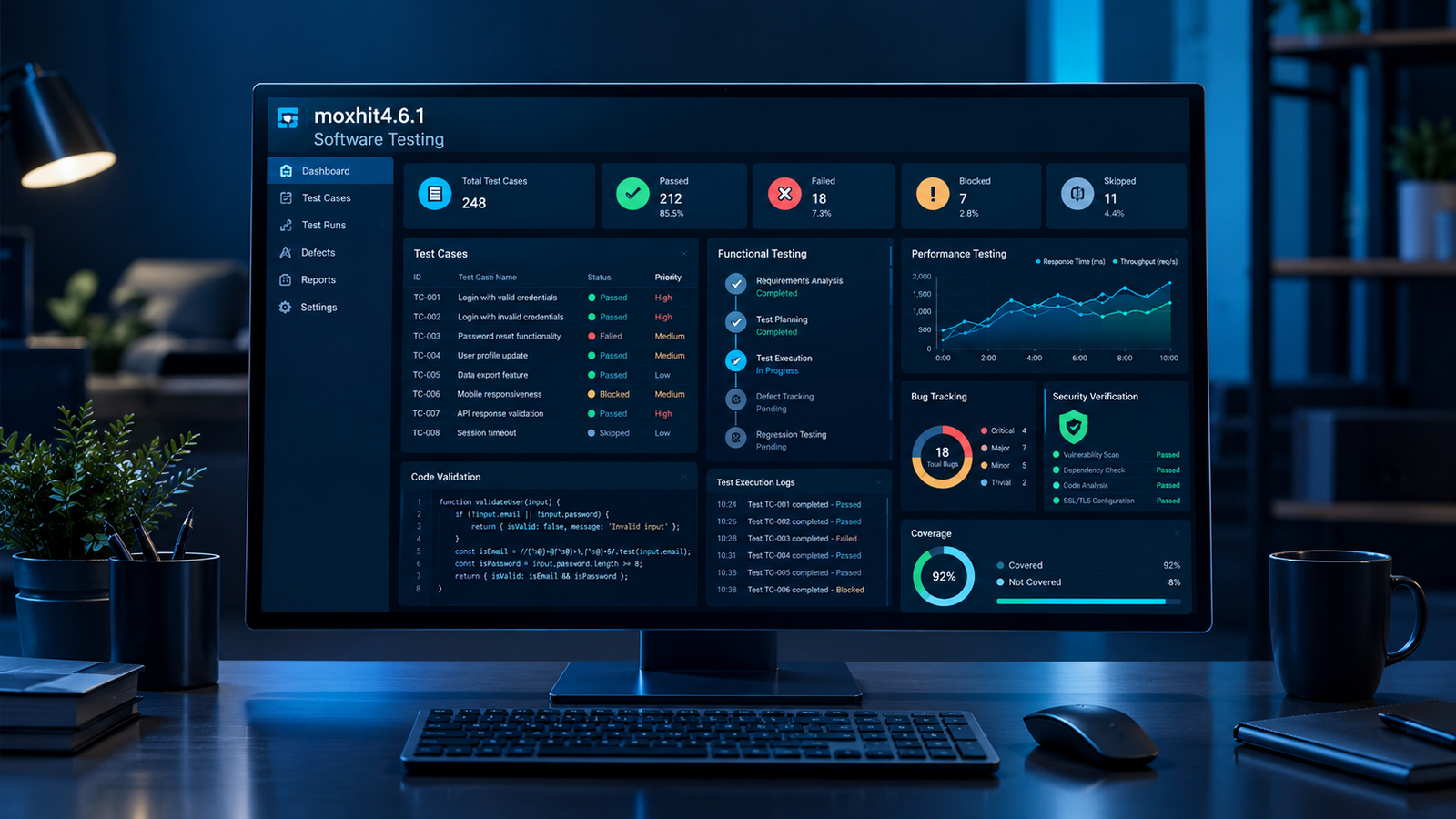
Software quality is built through careful planning, systematic evaluation, and continuous improvement. Every application, regardless of its size or intended purpose, must be examined to determine whether it behaves correctly, protects information, performs efficiently, and meets the expectations of its users. Software testing provides the structured process needed to make those judgments.
The term moxhit4.6.1 software testing has appeared in online discussions about software evaluation, quality assurance, and testing methodology. However, publicly available information does not establish a definitive official specification, verified developer, or complete feature list for Moxhit 4.6.1. Consequently, a responsible technical guide must distinguish established testing principles from unverified claims about a particular application.
This article explains how software identified as Moxhit 4.6.1 can be evaluated, which testing methods are appropriate, how testers can document their findings, and what precautions users should take before trusting an unfamiliar program. It also examines the meaning of version numbers, practical testing scenarios, defect management, security considerations, and the role of structured documentation in maintaining software quality.
Whether you are a beginner learning quality assurance, a developer examining an unfamiliar application, or a technical writer researching the subject, understanding these principles provides a reliable foundation for making informed decisions.
What Is Moxhit4.6.1 Software Testing?
Moxhit4.6.1 software testing can be understood as the process of examining a program identified by that name to determine whether its observable behavior satisfies documented requirements and reasonable expectations.
Software testing is not limited to opening an application and checking whether it starts. A comprehensive assessment examines individual functions, interactions between components, error handling, performance, security, compatibility, and recovery behavior.
For example, if an application accepts information from a user, a tester should examine whether valid information is processed correctly, invalid entries produce understandable errors, and sensitive information is handled appropriately. If the application saves files, testing should determine whether saved information remains accurate and can be retrieved reliably.
The specific tests appropriate for Moxhit 4.6.1 depend on what the program actually does. Without verified product documentation, it would be inaccurate to claim that the software necessarily includes automation engines, monitoring dashboards, data-processing modules, or other specialized capabilities.
Instead, testers should begin by identifying the program, establishing its intended purpose, and documenting the functions that can be confirmed through reliable evidence.
Why Software Testing Matters
Testing reduces uncertainty about how an application behaves under different conditions. Although no realistic testing process can guarantee that software contains no defects, a well-designed test strategy can identify important weaknesses before they cause significant problems.
The principal benefits include:
- Improved reliability: Repeated testing helps identify failures that occur during ordinary or extended use.
- Functional accuracy: Test cases establish whether the application produces the expected results.
- Better user experience: Interface problems, confusing messages, and inconsistent behavior become easier to identify.
- Stronger security: Appropriate checks can reveal weaknesses in access controls, data handling, and error management.
- Reduced maintenance costs: Discovering defects early can prevent expensive corrections after deployment.
- Greater confidence: Documented evidence allows stakeholders to make better-informed release decisions.
The phrase moxhit4.6.1 software testing biography table is very importantsnapjotz com may be used as a target search phrase, but its wording does not establish a recognized technical standard or official product specification. Its relevance should therefore be evaluated separately from the actual testing evidence.
Understanding the Name and Version Number
The name Moxhit4.6.1 appears to combine a product or project identifier with a version-like number. Software commonly uses numerical identifiers to distinguish releases, although the meaning of each component depends on the developer’s versioning policy.
A conventional version number such as 4.6.1 is often interpreted through semantic versioning or a similar scheme. In a common major-minor-patch model:
- Major version: The first number generally represents a substantial release or potentially incompatible changes.
- Minor version: The second number often indicates additional functionality that remains compatible with the major release.
- Patch version: The third number commonly identifies maintenance changes, bug fixes, or smaller corrections.
Under this convention, version 4.6.1 could represent a patch release within the 4.6 series. Nevertheless, the numbering alone cannot prove that the developer follows semantic versioning or that any particular correction was included.
A version number does not independently confirm that software is genuine, safe, current, or supported. It also does not establish a release date, development history, licensing model, or relationship with previous builds.
Information to Verify Before Testing
Before beginning a technical assessment, collect as much reliable information as possible about the application.
Useful details include:
- The complete program name and version identifier.
- The original download location or distribution channel.
- The publisher name and any available digital signature.
- The operating system and hardware requirements.
- The installation instructions and stated dependencies.
- The documented purpose and expected behavior.
- The license terms and support arrangements.
- The available release notes and known limitations.
If these details cannot be confirmed, record the gaps rather than filling them with assumptions.
A careful identification process is particularly important when a program is distributed through an unfamiliar website, shared archive, email attachment, or third-party download page.
The Main Objectives of Testing Moxhit4.6.1
A useful testing plan begins with clearly defined objectives. Without objectives, testers may spend time checking minor interface details while overlooking failures that could compromise data or prevent essential operations.
1. Verify Functional Behavior
Functional testing determines whether the application performs its documented tasks correctly.
Testers should identify each confirmed function and create test cases describing the required inputs, expected results, and observed outcomes.
For example, if a verified function allows users to save a configuration, testing should determine whether the configuration is stored accurately, remains available after restarting the program, and handles invalid values appropriately.
2. Assess Stability
Stability testing examines whether an application continues operating without unexpected crashes, corrupted data, or progressively worsening behavior.
The assessment may include repeated operations, extended sessions, interruptions, and the reopening of previously saved work.
3. Evaluate Performance
Performance testing measures responsiveness and resource consumption under defined conditions.
Depending on the program’s purpose, relevant measurements may include execution time, memory consumption, processor utilization, request latency, or processing throughput.
Performance claims should be supported by measurements rather than impressions.
4. Examine Security
Security testing evaluates whether the application protects information and restricts unauthorized actions.
The scope may include authentication, authorization, input validation, sensitive-data storage, dependency risks, and the handling of unexpected errors.
5. Confirm Compatibility
Compatibility testing determines whether the application behaves consistently across supported operating systems, hardware configurations, screen sizes, or dependency versions.
The appropriate environments should be based on documented requirements rather than speculation.
6. Assess Recovery and Error Handling
Applications should respond predictably when something goes wrong.
Testers can examine how the program behaves when a file is missing, a required service becomes unavailable, storage runs low, or an operation is interrupted.
The objective is not merely to provoke an error but to determine whether the software fails safely and communicates the problem clearly.
Essential Types of Software Testing
Different testing methods reveal different classes of defects. A comprehensive strategy selects methods according to the application’s purpose, architecture, risk level, and intended users.
Functional Testing
Functional testing compares actual application behavior with documented requirements.
A functional test usually specifies preconditions, inputs, actions, expected results, and the final outcome. Testers then execute the steps and record whether the observed behavior matches the expectation.
Suppose an application contains a verified file-import function. Appropriate test cases might include importing a valid file, attempting to import an unsupported format, selecting an empty file, and handling a file that is damaged.
The results should identify whether the application accepts valid input, rejects invalid input safely, and communicates failures without losing unrelated work.
For moxhit4.6.1 software testing, functional coverage should be based on features confirmed in the actual program rather than capabilities copied from unrelated descriptions.
Unit Testing
Unit testing examines individual components, functions, or small pieces of code in isolation.
Developers use unit tests to verify conditions such as calculations, input validation, formatting rules, and decision logic. Because these tests target small units, failures are generally easier to trace to their source.
For instance, a function that converts a numerical value into a formatted string could be tested with ordinary values, boundary values, negative numbers, and invalid input.
Unit testing is primarily a development activity. If the tester does not have access to the source code or internal components, direct unit testing may not be possible.
In that situation, external behavioral tests can still evaluate the program without claiming access to its internal implementation.
Integration Testing
Integration testing examines whether connected components exchange information correctly.
An application may behave correctly when its individual parts are tested separately but fail when those parts interact. Data-format mismatches, incorrect assumptions, configuration conflicts, and communication errors are common causes.
Integration tests should examine:
- Whether information reaches the intended component.
- Whether data retains its meaning during transfer.
- Whether dependencies return the expected responses.
- Whether failures in one component are handled by another.
- Whether errors are recorded accurately.
- Whether duplicate or incomplete operations create inconsistent results.
If Moxhit 4.6.1 is confirmed to integrate with external systems, the testing scope should include those interfaces. If no such integrations exist, integration tests should reflect the actual architecture instead.
System Testing
System testing evaluates the complete application in an environment that resembles its intended use.
It combines multiple functions and examines whether the entire system meets its requirements. This may involve installation, configuration, normal operation, error handling, data storage, and shutdown behavior.
System testing is especially useful because some defects emerge only after multiple components operate together.
A complete system test should also verify that the program’s documented installation and removal procedures work as expected.
Regression Testing
Regression testing checks whether a change has introduced a defect into previously functioning behavior.
Changes may include bug fixes, configuration updates, dependency upgrades, or modifications to application code. A correction to one function can unintentionally affect another.
A regression suite should prioritize essential workflows, previously reported defects, and areas that are closely connected to the modified component.
When comparing different Moxhit builds, testers should preserve the original results, document the differences between environments, and avoid assuming that a higher version number automatically means better quality.
Acceptance Testing
Acceptance testing determines whether software satisfies the needs of its intended users or stakeholders.
Technical correctness is important, but it does not always mean that an application is suitable for its intended purpose. A feature may work exactly as programmed while still failing to meet a business requirement.
Acceptance criteria should therefore be written in practical terms. They might specify that a required task can be completed successfully, information remains accurate after saving, or an error message clearly explains how to recover.
A program should not be considered acceptable merely because it launches without displaying an error.
Performance, Reliability, and Scalability Testing
Performance is an important dimension of software quality, but it must be measured in a controlled and repeatable manner.
Performance Testing
Performance testing evaluates how efficiently an application performs a defined workload.
The first step is to establish a baseline. Testers should record the environment, input size, execution conditions, and measurement method before interpreting results.
Useful metrics may include:
- Response time for a defined operation.
- Time required to complete a task.
- Memory consumption during execution.
- Processor utilization.
- Number of operations completed within a given period.
- Frequency and duration of timeouts.
A result such as “the program feels fast” is not sufficiently precise for a technical report. A statement such as “the operation completed within the agreed response-time threshold in repeated trials” is more useful when the underlying measurements are recorded.
Load Testing
Load testing evaluates behavior under an expected volume of work.
For a confirmed server-based application, this could involve increasing concurrent requests or the number of active users. For a desktop utility, it might involve larger datasets or repeated processing tasks.
The workload must reflect the software’s actual intended use. Applying unrealistic loads without a defined objective can produce results that are difficult to interpret.
Stress Testing
Stress testing pushes an application beyond its expected operating conditions to examine how it behaves near or beyond its limits.
The goal is to identify failure thresholds, unsafe behavior, resource exhaustion, and the system’s ability to recover.
Testing should take place in an isolated environment when a failure could affect important data, production systems, or other users.
Reliability Testing
Reliability testing examines whether the application can complete repeated operations consistently over time.
Testers should record crashes, failed operations, unexpected output, resource growth, and other signs of degradation.
If an application completes an operation successfully once, that result does not prove that it will remain reliable during extended use. Repeated tests under controlled conditions provide stronger evidence.
Scalability Testing
Scalability testing evaluates whether performance remains acceptable as workload or resource demands increase.
This is relevant when a verified application processes growing volumes of data, serves additional users, or handles more simultaneous operations.
If the program is a small standalone utility with no meaningful scaling requirements, elaborate scalability testing may offer little value. Test scope should always follow actual requirements.
Security Testing and Safe Evaluation
Security deserves particular attention when the identity or publisher of a program cannot be independently verified.
An unfamiliar application should not be granted unrestricted access to personal files, business credentials, administrative permissions, or sensitive networks merely because a webpage describes it as useful.
Verify the Source
Obtain the program through a source that can be independently associated with its developer or authorized distributor.
Check publisher details, available signatures, file integrity information, licensing terms, and release documentation. A digital signature can help establish publisher identity and detect certain forms of modification, but it does not guarantee that a program is free from vulnerabilities.
Inspect the File Before Execution
Use reputable security software to scan the downloaded file. Where available, examine its signature, file metadata, dependencies, and hash against trustworthy information supplied by the publisher.
A clean antivirus result is useful but not conclusive. Security tools can miss new threats, and a file can be legitimate while still containing software defects.
Use an Isolated Environment
If the program’s origin remains uncertain, avoid installing it directly on a primary computer.
A properly configured virtual machine or other isolated test environment can reduce the risk of unintended changes. Isolation should be supplemented by restricted permissions, limited network access, and the use of non-sensitive test data.
Do not assume that virtualization makes every activity completely safe.
Examine Permissions and Network Activity
Review the permissions the program requests and determine whether they are appropriate for its documented purpose.
Unexpected access to sensitive directories, unusual network connections, or attempts to obtain elevated privileges deserve investigation. Such observations are signals to examine further, not automatic proof of malicious behavior.
Protect Test Data
Testing should use synthetic or sanitized data whenever possible.
Real customer records, passwords, private documents, and production credentials should not be exposed unnecessarily. Logs and screenshots should also be reviewed for information that should not be shared.
For moxhit4.6.1 software testing, security findings should be documented separately from general functional results so that significant risks cannot be overlooked among routine defects.
Building a Practical Test Plan
A test plan turns broad quality objectives into a repeatable process. It establishes what will be tested, how results will be evaluated, and who is responsible for each activity.
Define the Scope
Start by listing the application’s verified features and the requirements that apply to each one.
Separate confirmed functions from assumed capabilities. If a function cannot be identified or documented, mark it as unresolved instead of inventing test coverage for it.
Identify the Test Environment
Record the operating system, application build, hardware, dependencies, configuration settings, and other conditions that may affect results.
A test result without environmental context is difficult to reproduce. Even minor differences between configurations can explain why an issue appears on one machine but not another.
Establish Entry Criteria
Entry criteria define the conditions that must be satisfied before testing begins.
Typical criteria include a stable test build, an available environment, documented requirements, prepared test data, and an agreed test scope.
For an unfamiliar application, confirming its identity and obtaining it from a trustworthy source should also be considered an essential preliminary step.
Define Exit Criteria
Exit criteria establish when the testing phase can be considered complete.
Examples include:
- All critical test cases have been executed.
- No unresolved defect exceeds the agreed severity threshold.
- Required functional workflows pass.
- Security risks have been assessed.
- Important regression tests have passed.
- Test evidence has been documented.
- Remaining limitations have been communicated to decision-makers.
Exit criteria should be agreed upon before results are known. Otherwise, teams may be tempted to lower expectations simply to declare testing complete.
Prioritize by Risk
Not all defects have the same consequences.
A failure that destroys important data is more serious than a minor visual inconsistency. A security weakness that exposes confidential information requires a different response from a cosmetic issue in a rarely used screen.
Risk-based testing prioritizes areas according to the likelihood of failure and the impact that failure could have.
This approach makes better use of limited time while keeping attention on the problems that matter most.
Example Test Cases for Moxhit4.6.1
The following examples illustrate a reusable testing structure. They are generic examples, not evidence that Moxhit 4.6.1 contains the functions described.
| Test ID | Test scenario | Expected result | Priority |
|---|---|---|---|
| TC-01 | Launch the verified application | The program starts according to its documented requirements | High |
| TC-02 | Enter valid information into a confirmed input field | The information is accepted and processed correctly | High |
| TC-03 | Submit invalid or incomplete information | The application handles the input safely and explains the problem | High |
| TC-04 | Save and reopen supported test data | The stored information remains accurate | High |
| TC-05 | Repeat a normal operation several times | Results remain consistent | Medium |
| TC-06 | Interrupt a non-destructive test operation | The application handles the interruption predictably | Medium |
| TC-07 | Examine resource consumption during a defined workload | Usage remains within the agreed limits | Medium |
| TC-08 | Attempt an unauthorized action in an approved test environment | Access is denied as required | High |
| TC-09 | Test a documented dependency failure | The failure is handled and reported appropriately | High |
| TC-10 | Repeat previously passed tests after a change | Existing behavior remains correct | High |
A test case should include more than a title and expected result. A complete record should contain the prerequisites, test data, exact steps, actual result, status, execution date, environment, and relevant evidence.
The phrase moxhit4.6.1 software testing biography table is very importantsnapjotz com may appear in search-oriented research notes, but it should not replace precise test-case names or established QA terminology in a professional test report.
A Step-by-Step Testing Workflow
A disciplined workflow helps testers move from uncertainty to evidence.
Step 1: Establish the Application’s Identity
Confirm the exact filename, version, publisher, and source. If the identity cannot be established, document that limitation before moving to more extensive testing.
Step 2: Review Available Documentation
Examine installation instructions, stated requirements, known limitations, licensing information, and release notes.
If official documentation is unavailable, use carefully labelled observations rather than treating unofficial descriptions as authoritative.
Step 3: Prepare a Controlled Environment
Use a test system with suitable access restrictions, a clean configuration, and non-sensitive test data.
Record the initial state so that changes can be traced to the test activity.
Step 4: Perform Basic Operational Checks
Verify the documented installation, startup, configuration, primary functions, and shutdown procedures.
These checks establish whether more detailed testing can proceed safely.
Step 5: Execute Functional Tests
Run the planned test cases in a repeatable order. Record actual results and compare them with the expected outcomes.
Do not change several conditions simultaneously unless the test is specifically designed to examine their combined effect.
Step 6: Investigate Failures
Repeat failed tests where safe, collect logs, isolate variables, and determine whether the failure is reproducible.
A failed test should be treated as evidence requiring investigation, not as automatic proof of a specific root cause.
Step 7: Conduct Non-Functional Tests
Evaluate performance, reliability, compatibility, and security according to the established scope.
Use measurable thresholds wherever possible.
Step 8: Retest Corrections
When a defect is corrected, rerun the original failing test and relevant regression tests.
A correction should not be considered verified solely because the developer reports that the change has been made.
Step 9: Prepare the Test Report
Summarize the scope, environment, executed tests, pass and fail counts, unresolved defects, risks, and recommended next steps.
The report should state what was tested and what remains untested. This distinction is essential for avoiding exaggerated claims about software quality.
Step 10: Make an Evidence-Based Decision
Determine whether the application is suitable for its intended use, requires additional work, or should remain restricted pending further verification.
The decision should reflect the seriousness of unresolved issues rather than the number of tests that passed in isolation.
Common Testing Challenges and How to Address Them
Testing unfamiliar software often involves practical difficulties that are not solved simply by running more test cases.
Incomplete Documentation
Without reliable requirements, testers may struggle to decide what correct behavior looks like.
The remedy is to establish testable expectations with the responsible developer, administrator, or stakeholder. When no authoritative answer is available, document the uncertainty and avoid presenting assumptions as facts.
Unclear Product Identity
A name may refer to an internal application, an experimental build, a renamed package, or an incorrectly identified file.
Verify the source and available metadata before assigning a definitive product description. If the identity remains unresolved, the test report should say so explicitly.
Unreproducible Defects
Some failures occur only under particular environmental conditions or after a specific sequence of actions.
Record the exact steps, inputs, configuration, timestamps, and relevant logs. A minimal reproduction sequence often makes an issue easier to investigate.
Inconsistent Test Environments
Different dependency versions, permissions, system settings, or hardware conditions can produce different results.
Maintain a record of the environment and change one variable at a time when investigating discrepancies.
Insufficient Test Coverage
A collection of passing tests does not necessarily mean that all important behavior has been examined.
Map test cases to requirements and prioritize untested areas according to risk. Coverage metrics are useful indicators, but they do not measure the quality of every test or prove that every possible defect has been found.
Time Constraints
Limited schedules can force teams to prioritize.
Risk-based testing provides a rational way to select high-impact scenarios first. Essential functions, data integrity, access controls, and recovery behavior generally deserve attention before low-impact cosmetic details.
Unclear Acceptance Criteria
Disagreement about what counts as success can delay testing and create disputes during release decisions.
Define measurable acceptance criteria before execution. Where a requirement is subjective, document the evaluation method and obtain agreement from the relevant stakeholders.
Defect Reporting and Issue Management
A defect report communicates a problem in a way that another person can understand, reproduce, prioritize, and resolve.
A useful report should contain:
- Defect identifier: A unique reference for tracking.
- Short title: A clear description of the observed issue.
- Environment: The software build, operating system, and relevant configuration.
- Prerequisites: Conditions required before reproducing the issue.
- Steps to reproduce: A numbered sequence of actions.
- Expected result: The documented or agreed behavior.
- Actual result: What happened during the test.
- Severity: The impact of the defect.
- Reproducibility: Whether the issue occurs consistently.
- Evidence: Relevant logs, screenshots, or test data, with sensitive information removed.
Severity and priority should be distinguished. Severity describes the impact of the defect, while priority describes how urgently the team should address it.
For example, a serious data-integrity issue may have high severity and high priority. A cosmetic issue may have low severity, although its priority could increase if it affects a prominent interface used by many customers.
Defects should remain traceable from discovery through investigation, correction, retesting, and closure.
Test Automation: Benefits and Limitations
Test automation uses scripts or specialized tools to execute checks with reduced manual effort. It can improve repeatability and accelerate regression testing, particularly when the same scenarios must be executed frequently.
However, automation is not automatically the best choice for every test.
Where Automation Helps
Automation is often valuable for:
- Repeated regression checks.
- Large sets of input combinations.
- Stable, well-defined workflows.
- Data validation across many records.
- Repetitive interface interactions.
- Consistent performance measurements.
- Continuous integration and build verification.
Automated tests can also help identify changes in behavior between builds, provided that the tests and expected results remain accurate.
Where Manual Testing Remains Useful
Manual testing is valuable when requirements are unclear, behavior is exploratory, visual judgment is important, or a tester needs to investigate an unexpected result.
Human observation can reveal usability problems that a narrow automated assertion would miss.
Risks of Poorly Designed Automation
Automated tests can become unreliable when they depend on fragile interface elements, unstable test data, timing assumptions, or undocumented behavior.
A failing automated test does not always indicate an application defect. It may reflect a problem in the test script, environment, or setup.
Likewise, a passing script proves only that its defined checks passed under the tested conditions.
If Moxhit 4.6.1 is confirmed to support scripting or automation, those capabilities can be evaluated separately. They should not be assumed from the software name alone.
Compatibility and Installation Verification
Installation testing checks whether a program can be deployed correctly in its intended environment.
A useful installation assessment examines the documented prerequisites, installation steps, configuration defaults, required permissions, and behavior after installation.
Installation Checks
Testers should verify whether the installation process completes successfully, whether expected files are present, and whether the application launches without unexpected errors.
They should also determine whether the installer requests permissions that are reasonable for the program’s stated purpose.
Upgrade Checks
If an earlier version can be reliably identified, an upgrade test may determine whether supported settings and data are preserved.
Before attempting an upgrade, back up relevant test data and confirm the documented recovery procedure. An unfamiliar installer should not be used to modify a production system without appropriate authorization.
Uninstallation Checks
Uninstallation testing determines whether the application can be removed cleanly and whether removal affects unrelated files or settings.
Any data-retention behavior should be consistent with documented expectations and applicable privacy requirements.
Platform Compatibility
Test the application only on platforms it claims to support or on platforms required by the intended deployment.
A failure on an unsupported environment does not automatically indicate a product defect. The environment and its support status must be considered when interpreting results.
Reporting Results with a Biography Table
The phrase “biography table” ordinarily suggests a compact summary of identifying information, background, or key attributes. It is not a standard software-testing term, but a profile-style table can help readers understand what has and has not been verified about a program.
For an unfamiliar software name, the table should distinguish available observations from missing evidence.
| Information field | Current assessment |
|---|---|
| Software name | Moxhit4.6.1 |
| Apparent version identifier | 4.6.1 |
| Verified developer | Not established by the available evidence |
| Official product documentation | Not independently established |
| Confirmed feature list | Unavailable |
| Testing approach | Requirements-based functional and non-functional testing |
| Security status | Requires assessment of the actual file and its source |
| Compatibility | Must be checked against verified requirements |
| Release history | Not confirmed |
| Recommended next step | Establish identity, source, requirements, and intended purpose |
This table is a research-status summary, not an official product biography. Its contents should be updated if trustworthy documentation becomes available.
The keyword moxhit4.6.1 software testing biography table is very importantsnapjotz com can be useful when examining the relationship between a search phrase and a requested profile table. However, the unusual wording should not be mistaken for a technical requirement or proof of a product’s identity.
How to Evaluate Documentation Quality
Documentation is one of the most useful sources of information during software evaluation. It explains intended behavior and gives testers a standard against which results can be compared.
High-quality documentation usually identifies the publisher, supported environments, installation requirements, available functions, known limitations, and release history.
Look for Consistency
The product name, version number, publisher, and technical details should agree across relevant materials.
Contradictions between different descriptions deserve attention, particularly when they concern the application’s purpose or security requirements.
Check Whether Claims Are Testable
Statements such as “improves performance” or “provides advanced security” are too vague to establish quality on their own.
A useful claim should identify the behavior being measured, the conditions under which it applies, and the expected result.
Separate Evidence from Marketing
Marketing language describes intended benefits, but it does not independently prove that those benefits are achieved.
Testing evidence should include reproducible steps, measured outcomes, and a clear description of the environment.
Record Missing Information
When documentation is unavailable, maintain a list of unresolved questions.
This practice is more useful than filling gaps with details copied from unrelated programs or speculative online articles.
Understanding Test Results and Quality Metrics
Testing produces evidence that must be interpreted carefully. The number of successful test cases is one useful measurement, but it does not tell the entire story.
Pass Rate
Pass rate is calculated by dividing the number of passed tests by the total number of tests executed, then multiplying by 100.
For example, if 90 out of 100 executed tests pass, the pass rate is 90 percent.
This figure is meaningful only when the test set is understood. A high pass rate among low-risk scenarios can coexist with a serious unresolved security defect.
Defect Density
Defect density compares the number of identified defects with a defined unit of software size, such as thousands of lines of code or a functional component.
It is most useful when the measurement method is consistent and comparisons involve reasonably similar systems. It should not be used as a universal quality score.
Test Coverage
Coverage measures which requirements, code paths, functions, or other defined elements have been examined.
Different coverage measures answer different questions. Requirement coverage, for example, does not establish that every relevant code path has been executed.
Mean Time Between Failures
Mean time between failures is a reliability measure commonly used for systems that experience repeated operational failures. Its interpretation depends on the observation period, failure definition, and operating conditions.
It should not be presented as a meaningful result when the testing period or failure data is insufficient.
Defect Leakage
Defect leakage describes problems that escape one testing stage and are discovered later, such as after release.
Tracking escaped defects can help teams improve test coverage, requirements, and release procedures.
No single metric can establish that an application is completely safe or defect-free. Metrics become more valuable when interpreted together with risk, test scope, and the seriousness of unresolved findings.
Best Practices for More Effective Testing
A strong testing process combines technical discipline with clear communication.
Begin with verified requirements. Establish what the program is intended to do before deciding how to test it.
Use reproducible test cases. Write steps that another tester can follow without relying on undocumented assumptions.
Prioritize important risks. Focus first on failures that could cause data loss, security exposure, major disruption, or incorrect results.
Maintain controlled environments. Record configurations and avoid unnecessary changes during test execution.
Use realistic but safe data. Prepare representative test inputs without exposing sensitive information.
Retest corrections. Confirm that a reported defect is resolved and that related functionality still works.
Keep clear records. Preserve test results, environmental details, and relevant evidence.
Communicate limitations. State which areas were tested, which were excluded, and what remains uncertain.
Avoid unsupported claims. Do not describe unverified features as established facts.
Review findings before release. Ensure that decision-makers understand the outstanding defects and the risks associated with them.
These principles make moxhit4.6.1 software testing more meaningful because they focus attention on observable behavior and documented evidence rather than assumptions about the product.
Frequently Asked Questions
1. What is moxhit4.6.1 software testing?
It refers to evaluating software identified as Moxhit4.6.1 through established quality-assurance methods. Testing can examine functionality, stability, compatibility, performance, security, and error handling. The exact scope depends on the application’s verified purpose and requirements.
2. What is Moxhit4.6.1 software used for?
Its precise purpose has not been established by clearly verified public product documentation. Different online descriptions associate the name with different technical uses, so those claims should not be treated as confirmed specifications. The source, publisher, and actual behavior of the program are more reliable starting points.
3. Is Moxhit4.6.1 an official software-testing tool?
There is insufficient verified evidence to classify it definitively as an established testing tool. It may be discussed as a subject of software testing, but that does not prove that it is a dedicated testing platform or that it contains built-in testing features.
4. How can I test Moxhit4.6.1 safely?
First, verify the source and publisher as far as possible. Review available documentation, scan the file with reputable security software, and use an isolated test environment if its identity remains uncertain. Avoid sensitive data, unnecessary administrator privileges, and unrestricted network access.
5. Which testing methods are most important?
Functional testing, integration testing where applicable, system testing, regression testing, security assessment, and error-handling checks are useful starting points. Performance, reliability, and compatibility testing should be added according to the application’s actual requirements and risks.
6. Does version 4.6.1 mean the software is safe?
No. A version number identifies a release or build according to a numbering scheme, but it does not establish authenticity, security, quality, or support status. Safety requires separate evidence about the publisher, file integrity, vulnerabilities, and actual behavior.
7. Can beginners perform Moxhit4.6.1 software testing?
Yes, beginners can perform basic testing if they have legitimate access to the program and a clear understanding of the intended behavior. They can start by checking documented functions, recording expected and actual results, and reporting reproducible problems. Security-sensitive or destructive tests require additional knowledge and appropriate safeguards.
8. What should a software test case contain?
A test case should identify its purpose, prerequisites, inputs, steps, expected outcome, actual result, execution environment, and status. Including a unique identifier makes it easier to connect results with requirements and reported defects.
9. What is the difference between functional and non-functional testing?
Functional testing examines what the application does and whether its functions produce the expected results. Non-functional testing evaluates qualities such as performance, reliability, security, usability, and compatibility. Both are necessary for a balanced assessment.
10. How do I know whether a test has passed?
A test passes when the observed result satisfies its predefined acceptance criteria under the recorded conditions. The criteria should be established before execution whenever possible. If the outcome is ambiguous or the environment is unsuitable, the test may need to be marked blocked or inconclusive rather than passed.
11. What should I do if Moxhit4.6.1 crashes during testing?
Record the steps that preceded the crash, the environment, relevant logs, and whether the failure can be reproduced. Avoid repeating destructive operations on valuable data. If the program’s identity or origin is uncertain, stop using it on a primary device until the risk has been assessed.
12. Is test automation necessary?
Not always. Automation is especially valuable for repetitive, stable, and frequently executed tests. Manual testing remains useful for exploratory work, unclear requirements, and subjective usability assessments. The best approach depends on the project’s needs, resources, and risk profile.
13. How should testing results be documented?
A useful report describes the application build, environment, scope, methods, test outcomes, defects, unresolved risks, and limitations. It should distinguish confirmed findings from assumptions and provide enough evidence for another person to understand the conclusions.
14. Why is a software biography table useful?
A profile table can summarize a program’s name, apparent version, verified publisher, documentation status, compatibility information, and outstanding questions. For poorly documented software, it is especially useful for making uncertainty visible instead of presenting unsupported details as established facts.
15. What does moxhit4.6.1 software testing biography table is very importantsnapjotz com mean?
The phrase appears to combine a software-testing topic, a request for a biography-style table, and the text “snapjotz com.” Its wording does not establish an official product, recognized testing method, or verified relationship between the named elements. If the phrase comes from a particular website or source document, that context would help determine its intended meaning.
16. Can passing all test cases guarantee perfect software?
No. Passing tests demonstrates that the tested scenarios met their defined criteria under the conditions used. Unexamined inputs, undiscovered defects, environmental differences, and future changes can still introduce problems. Testing reduces uncertainty but cannot establish absolute perfection.
17. When should testing stop?
Testing can stop when the agreed exit criteria have been met, required coverage has been achieved, critical risks have been addressed, and remaining limitations are understood by the responsible decision-makers. A deadline alone is not evidence that a program is ready for release.
A Practical Readiness Checklist Before Trusting the Software
Before relying on an unfamiliar application, use the following checklist to determine whether the available evidence is sufficient for the intended purpose.
- The software’s source and identity have been checked.
- The publisher or responsible organization has been identified where possible.
- The intended purpose and required functions are documented.
- Installation and system requirements have been reviewed.
- The application has been evaluated in an appropriate environment.
- Essential functional tests have been completed.
- Relevant error-handling and recovery scenarios have been examined.
- Security risks and permission requirements have been assessed.
- Test results and defects have been documented.
- Important unresolved issues have been communicated.
- The decision to use the application reflects the evidence and the consequences of failure.
A checklist does not replace professional judgment, but it provides a repeatable way to identify missing information before a decision is made.
From Uncertainty to Evidence: The Next Step
The most valuable outcome of software testing is not a claim that a program is perfect. It is a clear understanding of what the program does, how reliably it performs, which risks remain, and what evidence supports the decision to use it.
For Moxhit4.6.1, the first priority is to establish a trustworthy identity and obtain reliable information about its intended purpose. Once that foundation exists, conventional testing techniques can be applied systematically, with test cases tied to requirements and results recorded in a reproducible format.
The expression moxhit4.6.1 software testing biography table is very importantsnapjotz com should be treated as a search phrase rather than technical evidence. A credible assessment depends on verifiable documentation, controlled experiments, measurable outcomes, and transparent reporting.
Ultimately, a disciplined approach to moxhit4.6.1 software testing helps readers and technical teams make decisions based on evidence rather than speculation. The same approach applies to any unfamiliar software: identify it carefully, test what can be verified, document what remains unknown, and make every quality claim proportionate to the evidence available.
