
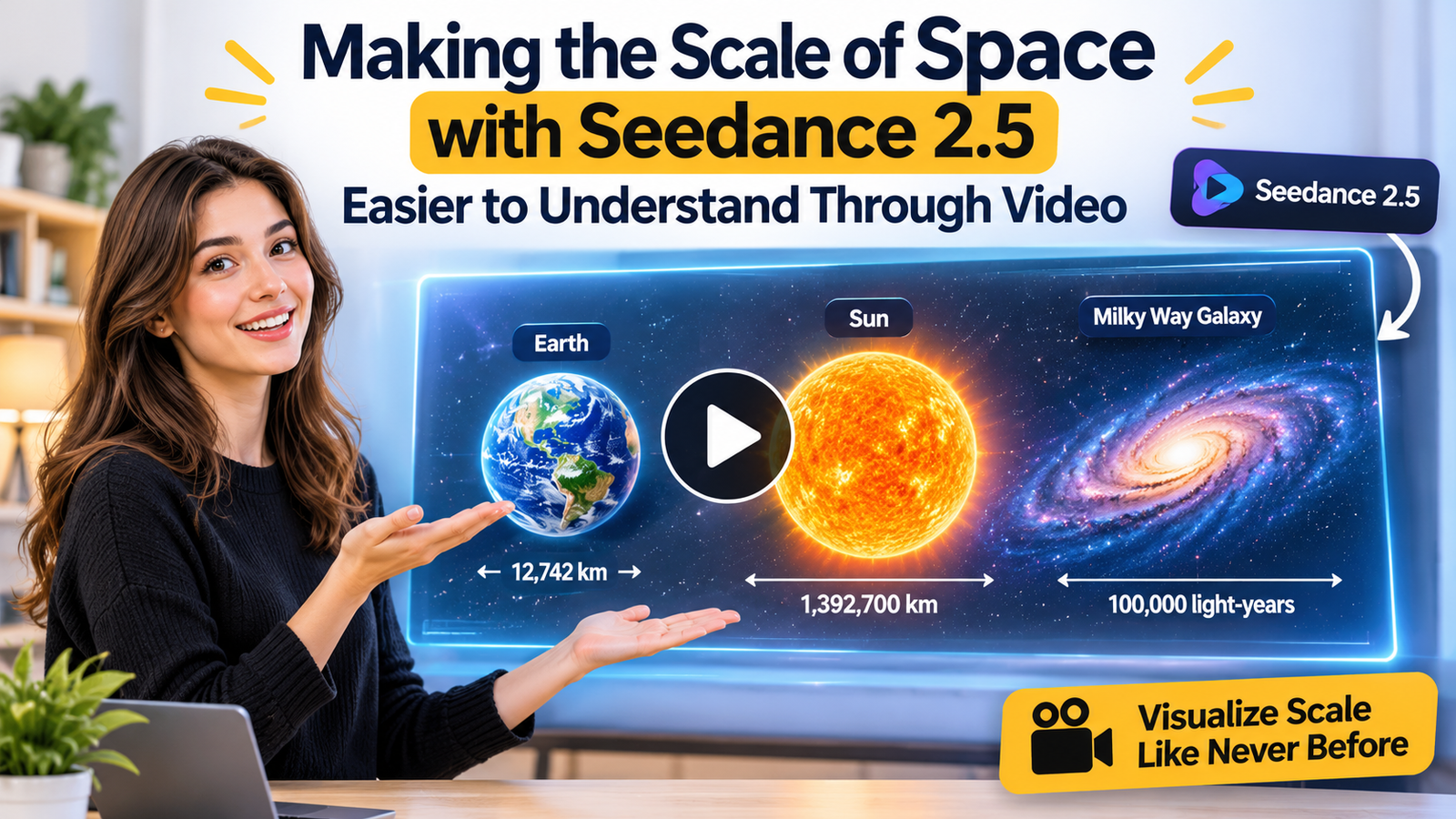
Space is full of things that are difficult to imagine. The distance between planets, the size of stars, and the movement of galaxies are often explained through numbers that are far beyond everyday experience. Even when learners understand the figures, they may struggle to picture what those measurements actually mean.
Visual storytelling can make these subjects more approachable. Seedance 2.5 offers creators an opportunity to explore AI-assisted videos that turn astronomical concepts into visual explanations. By combining movement, comparison, and carefully planned scenes, educators can help viewers develop a clearer sense of the universe without making every lesson feel like a mathematics exercise.
Put Enormous Distances into Perspective
One of the biggest challenges in astronomy education is explaining distance. Terms such as kilometres, astronomical units, and light-years describe measurements that are difficult to connect with familiar experiences. A video can introduce these ideas through comparisons. For example, an educational sequence might begin with the distance between two nearby objects on Earth, then gradually expand the view to show the distance between Earth and the Sun. The explanation can continue outward to introduce the distances between stars.
The purpose is not to make space appear smaller than it is. It is to give learners a visual reference before introducing the actual measurements. Creators using seedance 2.5 can explore ways to present these comparisons through changing viewpoints and illustrative scenes. Each stage should be labelled clearly so viewers understand when the video has moved from one scale to another.
Explain Orbital Movement Without Overloading the Viewer
Planets, moons, and other celestial objects follow different paths and move at different speeds. Explaining these movements through written descriptions alone can be challenging, particularly for younger learners. A visual sequence can show a planet travelling around a star while introducing the idea of an orbit. Another scene could demonstrate how a moon moves around its planet. These simple examples help viewers distinguish between different types of movement.
It is important to explain that many educational animations simplify orbital motion. A diagram may use circular paths or represent objects moving at a convenient speed, even though actual orbits and distances can be more complex. An AI video generator can help creators explore visual explanations, but the scientific meaning should remain the priority. The animation should support the lesson rather than introduce movements that contradict the concept being taught.
Use Different Perspectives to Explore the Same Object
Astronomical objects can look very different depending on the viewpoint. A planet viewed from a distant spacecraft may appear as a small sphere, while a closer illustrative view can reveal its surface features and atmosphere. This change in perspective can help explain why scientific images offer different kinds of information. A wide view introduces the object’s place in space, while a closer view can focus on its characteristics.
Consider a video about Saturn. It could begin with the planet appearing within the wider solar system, then move towards a closer illustration of its rings. The narration could explain that the rings contain numerous particles and are not a solid structure surrounding the planet. Dreamina can be included in the creative workflow when developing visual concepts for astronomy lessons. However, generated scenes should be identified as illustrations when they are not based on actual telescope or spacecraft imagery.
Make Invisible Scientific Processes Easier to Picture
Some astronomical ideas cannot be observed directly in an ordinary way. The formation of stars, the movement of matter around a black hole, and the life cycle of a star involve processes that take place over enormous distances or periods. Visual explanations can present these processes as simplified sequences. A lesson about star formation, for instance, might introduce a cloud of gas and dust, show material gathering under gravity, and then explain how a star can eventually develop.
Such scenes are educational representations, not recordings of an event happening in real time. The distinction matters because dramatic visual effects may create an incorrect impression if they are not accompanied by an accurate explanation. Creators should work from dependable astronomy material and have scientific content reviewed when necessary. The purpose of an illustration is to make an established concept easier to understand, not to replace evidence with an attractive visual.
Turn Common Questions into Short Lessons
Many people approach astronomy with questions rather than a specific scientific topic. Why does the Moon appear to change shape? Why do we have different seasons? Why does the Sun look larger near the horizon? These questions can provide strong starting points for short educational videos. Each one offers a clear problem that the video can answer through a sequence of observations and explanations.
A lesson about the Moon’s phases, for example, could show how sunlight illuminates different portions of the Moon as its position changes relative to Earth and the Sun. This can help correct the common misunderstanding that the Moon’s shape physically changes throughout the month. Keeping one question at the center of a video also makes it easier to decide what information belongs in the lesson. Additional details can be saved for another video rather than making the explanation unnecessarily complicated.
Make Astronomy Suitable for Different Age Groups
An ai video generator can help present the same scientific subject at different learning levels. Younger learners may need familiar comparisons and simple language, while older students may benefit from more detailed explanations of gravity, orbital motion, and astronomical measurements. A video about light-years could introduce the idea through the time light takes to travel. A more advanced version might explain how astronomers use this measurement to describe distances beyond the solar system.
Seedance 2.5 can be explored as part of developing these different visual presentations. Regardless of the audience, important scientific terms should be used correctly, and examples should not imply that a simplified model contains every detail of the real process.
Protect Scientific Accuracy During Creative Production
Space imagery often looks dramatic, but realism alone does not make an educational video accurate. The size of objects, their relative positions, movement, and colours may be adjusted for presentation. These choices should not confuse viewers about the actual science.
A final review should examine whether the visuals match the narration and whether measurements or labels are correct. It is also useful to identify artistic reconstructions, simplified diagrams, and genuine scientific images separately. This gives audiences a better understanding of what they are watching and helps maintain trust in the educational material.
Conclusion
Astronomy becomes easier to explore when learners can connect scientific measurements and processes with clear visual examples. Videos can help explain enormous distances, orbital movement, changing perspectives, and events that cannot be observed directly. Seedance 2.5 provides an opportunity to develop AI-assisted visual lessons around these fascinating subjects. With careful research, appropriate illustrations, and clear explanations, creators can make space science more accessible while respecting the accuracy and complexity of the universe.
Frequently Asked Questions
Can an AI-generated video show the actual size of planets accurately?
It can present size comparisons when the measurements and proportions are carefully planned. However, some educational scenes may adjust proportions to make objects visible, so viewers should be told when a comparison is not to scale.
Why are astronomical distances difficult to explain?
Many distances in space are far beyond familiar human experience. Visual comparisons and clearly labelled scales can help learners understand the difference between nearby objects and distant stars or galaxies.
Can astronomy videos use imaginary spacecraft journeys?
Yes, fictional journeys can provide an engaging way to introduce scientific ideas. They should be presented as imaginative illustrations rather than real missions or recorded events.
How can creators prevent space videos from spreading scientific misconceptions?
They should check facts against dependable astronomy resources, use accurate labels, and review whether the visuals support the explanation. Simplified scenes should also be identified when they might otherwise be misunderstood.
Are short videos useful for teaching complex astronomy topics?
Yes. A short video focused on one question or concept can make a lesson easier to follow. More advanced subjects can be divided into connected episodes so learners can build their understanding gradually.
