
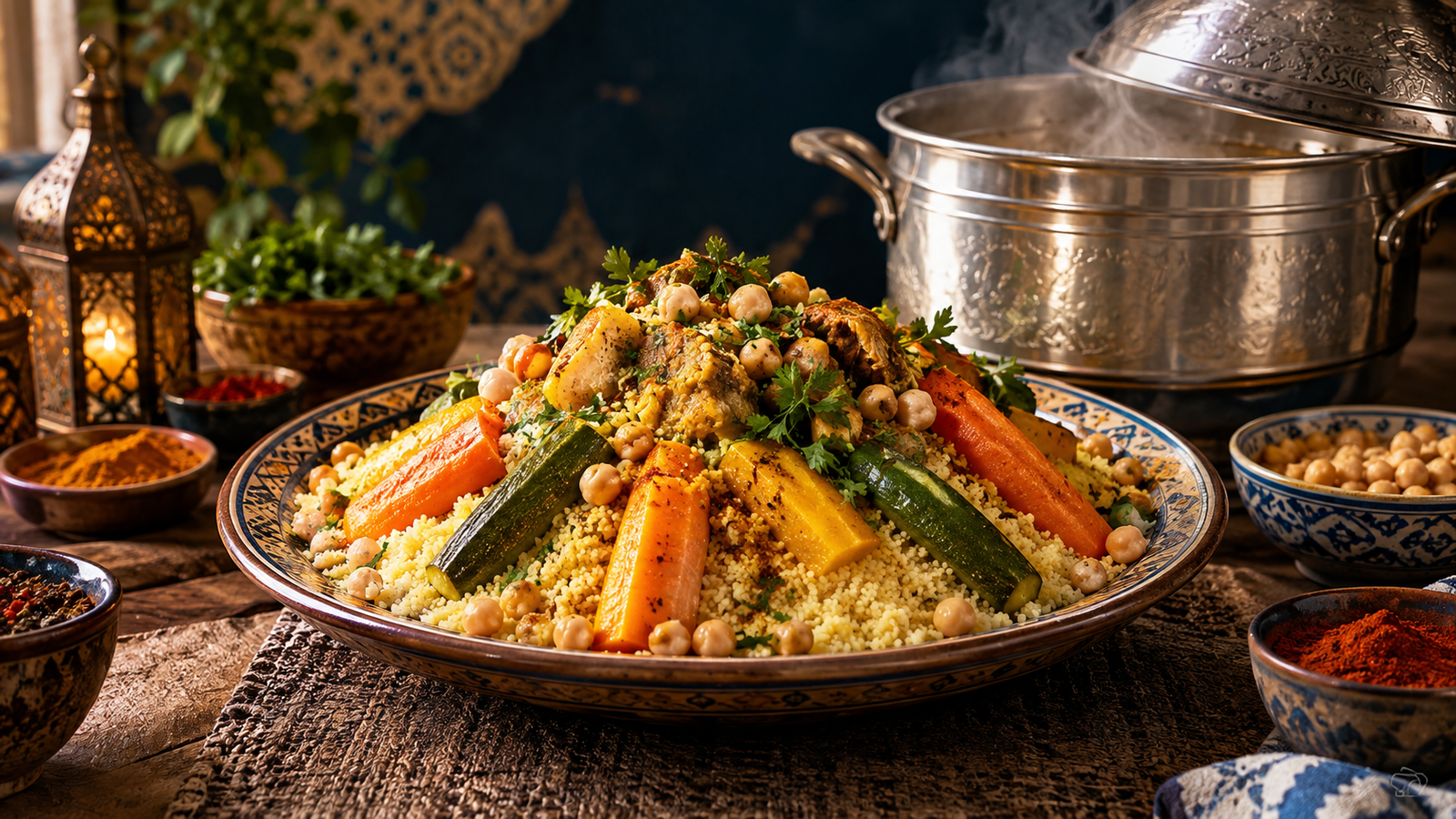
The word “kouskousi” can be surprisingly difficult to define with absolute precision because its spelling appears in several culinary and linguistic contexts. In contemporary online usage, it is commonly associated with couscous, the celebrated semolina-based staple of North African cuisine. At the same time, similar spellings can refer to small pasta products in parts of the Mediterranean and southeastern Europe. This makes context particularly important when interpreting the term.
The most useful way to understand kouskousi is therefore not to treat it as a single universally standardized product without qualification, but to examine the culinary traditions, ingredients, preparation methods, terminology, and regional practices associated with the name. Well-established documentation of couscous describes a food made primarily from durum-wheat semolina that is formed into small granules and traditionally steamed. UNESCO recognized the knowledge and practices connected with couscous production and consumption as Intangible Cultural Heritage in 2020 through a joint nomination involving Algeria, Mauritania, Morocco, and Tunisia.
This article explores the meaning of kouskousi, its relationship with couscous, its historical background, preparation techniques, nutritional characteristics, regional variations, cultural importance, and place in contemporary cooking. Because the spelling itself is not used consistently across sources, the article also distinguishes established culinary traditions from claims that should be treated cautiously.
What Is Kouskousi?
Kouskousi is most commonly encountered online as a spelling or transliteration associated with couscous, particularly the small semolina granules central to North African cooking. Couscous is produced from durum wheat semolina and water, with the mixture worked into tiny particles that are traditionally steamed rather than simply boiled.
The resulting food occupies an interesting position between grain and pasta. Although couscous visually resembles a grain such as rice or millet, it is manufactured from wheat semolina. This means that it is more accurately understood as a pasta-like cereal product rather than an independent grain crop.
The term kouskousi can therefore lead to confusion. Some sources use it as a name connected to couscous, while others use similar terminology for small pasta products. One recent culinary source, for example, describes a Greek usage involving small rounded pasta, particularly in regional cooking.
That distinction matters because preparation can differ considerably. Traditional North African couscous is commonly steamed, whereas small pasta products may be boiled or simmered in liquid.
For anyone researching kouskousi, the safest interpretation is to consider the geographical and culinary context rather than assuming every appearance of the word refers to exactly the same product.
Kouskousi Biography Table: What Should It Contain?
Because kouskousi is primarily a culinary term rather than a documented individual, conventional celebrity biography details such as age, height, education, relationships, or occupation are not appropriate. A useful kouskousi biography table is very important because it should instead explain the subject through culinary facts.
| Attribute | Information |
|---|---|
| Name | Kouskousi |
| Common association | Couscous and related small semolina products |
| Principal ingredient | Durum wheat semolina in the couscous tradition |
| Culinary category | Wheat-based staple / pasta-like food |
| Strongest regional association | North Africa and the wider Mediterranean context |
| Traditional preparation | Steaming for North African couscous |
| Common accompaniments | Vegetables, legumes, meat, fish, sauces, and broth |
| Texture | Light, granular, tender, and absorbent when properly prepared |
| Gluten status | Generally contains gluten because it is wheat-based |
| Cultural importance | Particularly significant in Maghrebi food traditions |
| UNESCO connection | Couscous-related knowledge and practices were inscribed in 2020 |
| Main source of terminology confusion | Regional spellings, transliterations, and similarly named pasta |
A kouskousi biography table is very important for another reason: it prevents readers from mistaking a food term for the biography of a person. Search queries often produce unusual combinations of words, and a clear introductory table gives readers an immediate framework for understanding what they are researching.
The Relationship Between Kouskousi and Couscous
The strongest established culinary connection is between kouskousi and couscous.
Couscous is one of the best-known foods associated with the Maghreb. It has developed into a major culinary symbol of North Africa while also becoming widely consumed internationally. Its production involves semolina being moistened, formed into small granules, and cooked through steaming.
Several recent sources use kouskousi as a spelling variant or regional rendering of couscous.
However, not every source uses the word identically. Other references associate similar terminology with small pasta in Greek culinary traditions.
Consequently, saying that every instance of kouskousi is automatically identical to North African couscous would oversimplify the terminology.
A better approach is:
- In a North African context, kouskousi may point toward couscous.
- In a Greek or Mediterranean pasta context, similar terminology may describe a small pasta product.
- In online content, the spelling can sometimes be used loosely.
- Ingredient lists and preparation instructions provide the most reliable clues for packaged products.
This distinction is particularly useful for readers purchasing an unfamiliar ingredient.
Historical Background of Couscous
The history underlying kouskousi is closely connected with the long history of couscous in North Africa.
Food historians generally associate couscous with the indigenous Amazigh communities of North Africa, although the precise chronology of its earliest development is difficult to establish. The food became deeply embedded in the culinary traditions of the Maghreb and developed numerous regional preparations.
Rather than belonging to one modern nation, couscous reflects a broader North African culinary heritage. Algeria, Mauritania, Morocco, and Tunisia jointly participated in the UNESCO nomination recognizing knowledge and practices related to couscous production and consumption.
This shared recognition is significant because food traditions do not necessarily follow modern political borders. Culinary practices can predate the contemporary countries in which they are now celebrated.
The development of couscous was also practical. Semolina could be transformed into small granules, dried, stored, and later cooked with vegetables, legumes, meat, fish, or flavorful broth. This combination of practicality and adaptability helped the food become deeply rooted in household cooking.
Why Semolina Is Important
Durum wheat is central to traditional couscous because it provides semolina, a coarse wheat product with characteristics well suited to forming small granules.
The semolina is moistened and worked until particles develop. Traditional preparation requires skill because the desired granules should remain distinct rather than becoming one sticky mass.
The process reflects a broader principle found in traditional food cultures: relatively simple ingredients can produce distinctive foods when technique is carefully controlled.
In couscous preparation, the size and consistency of the granules influence how quickly they cook and how they feel when eaten. Fine couscous becomes tender relatively quickly, while larger or differently manufactured forms may require different cooking times.
Traditional Preparation Methods
Traditional couscous preparation is more involved than simply pouring boiling water over dry grains.
A classic technique uses a two-part cooking vessel commonly known as a couscoussier. The lower section contains a stew or simmering liquid, while the upper perforated section holds the couscous. Steam rises from below and gradually cooks the granules.
This method provides two important advantages.
First, the couscous is cooked gently by steam rather than being submerged in water. Second, the grains can absorb aromas from the surrounding preparation while retaining their characteristic granular structure.
Traditional preparation may involve multiple steaming stages. The grains can be removed, loosened, moistened, and returned to the steamer as the cooking progresses.
This is considerably different from instant commercial couscous, which is often designed for rapid preparation.
Why Steaming Matters
Steaming helps create the texture associated with traditional couscous.
When couscous is handled correctly, the individual particles remain relatively separate and tender. Poorly managed moisture can cause clumping, while excessive cooking can produce a heavy or mushy texture.
Steam also allows cooks to prepare couscous alongside a flavorful stew. The cooking process becomes more than a method of heating food; it becomes part of the dish’s overall flavor architecture.
The importance of steaming is one of the clearest differences between traditional North African couscous and many small pasta products that may carry similar names.
Ingredients Commonly Used With Kouskousi
Kouskousi, when used to describe couscous, is highly adaptable because the semolina granules have a relatively mild flavor.
Common accompaniments include:
- Carrots
- Potatoes
- Turnips
- Chickpeas
- Zucchini
- Onions
- Tomatoes
- Lamb
- Chicken
- Beef
- Fish
- Seafood
- Raisins and other dried fruits
- Aromatic herbs
- Spices
- Broth-based sauces
The combination varies enormously by region and household.
A vegetable-centered preparation can be hearty and satisfying without relying on meat. Meat-based versions may use slow-cooked lamb or poultry, while coastal traditions can incorporate fish or seafood.
This flexibility is one reason couscous has remained relevant in both traditional and modern kitchens.
Regional Diversity
There is no single universally correct couscous recipe.
North African cuisine contains substantial regional diversity, and the treatment of couscous reflects that variety.
Moroccan Traditions
Moroccan couscous is often associated with vegetables, chickpeas, and meat served over fluffy semolina. Spice combinations can include cumin, ginger, turmeric, cinnamon, saffron, or pepper depending on the preparation.
Some Moroccan dishes combine savory ingredients with sweet elements such as raisins or caramelized onions.
Tunisian Traditions
Tunisian couscous can be more strongly associated with bold seasoning and chili-based flavors. Harissa is particularly important in Tunisian cuisine and may contribute heat and depth to couscous preparations.
Fish couscous is also an important part of Tunisian culinary culture, especially in coastal areas.
Algerian Traditions
Algerian couscous encompasses numerous regional preparations. Ingredients and flavor profiles differ depending on geography, household traditions, and local availability.
Vegetables, chickpeas, meat, and sauces can all feature prominently.
Mauritanian Traditions
Mauritanian culinary culture also includes couscous-related traditions, and the country’s participation in the UNESCO nomination highlights the shared heritage surrounding the food.
These examples demonstrate why it is misleading to reduce couscous to a single recipe.
Kouskousi and Small Mediterranean Pasta
Another important source of confusion is the use of similar terminology for small pasta.
A recent Greek-focused source describes kouskousi as a small rounded pasta associated particularly with Thrace and northeastern Greece. Such pasta can be made from wheat-based ingredients and prepared through boiling or simmering rather than the steaming process traditionally associated with North African couscous.
This version can be incorporated into:
- Soups
- Broths
- Stews
- Vegetable dishes
- Meat dishes
- Seafood preparations
- Sauced pasta dishes
The similarity in name and appearance explains why internet searches can produce apparently contradictory descriptions.
The important lesson is that the word should not be interpreted without context.
What Does Kouskousi Taste Like?
When kouskousi refers to traditional couscous, its own flavor is relatively mild.
The semolina contributes a gentle wheat character, but the food is especially valued for its ability to absorb surrounding flavors.
This makes it similar in culinary function to rice, bulgur, or other neutral starches. The final flavor depends heavily on the ingredients accompanying it.
A well-prepared couscous should not be flavorless, however. The cooking liquid, seasoning, vegetables, herbs, meat, or fish can transform it into a highly aromatic dish.
Texture is equally important. Properly steamed couscous should be tender while retaining enough structure to distinguish individual grains.
Nutritional Characteristics
Because traditional couscous is made from durum wheat semolina, it primarily provides carbohydrates.
The nutritional profile varies according to the type of couscous, portion size, preparation method, and accompanying ingredients.
Plain couscous can contribute:
- Carbohydrates for energy
- Some protein
- Small amounts of fiber
- Various micronutrients naturally present in wheat
- Additional nutrients when fortified, depending on the product
The nutritional composition becomes much more substantial when couscous is combined with vegetables, legumes, meat, fish, or nuts.
Chickpeas, for example, can add plant protein and fiber. Vegetables contribute vitamins, minerals, and phytochemicals. Meat and seafood can contribute protein and other nutrients.
It is therefore more meaningful to evaluate a complete couscous meal than to judge plain semolina alone.
Is Kouskousi Gluten-Free?
If kouskousi refers to conventional couscous made from durum wheat semolina, it is not gluten-free.
Wheat contains gluten, making traditional wheat-based couscous unsuitable for people who must avoid gluten for medical reasons.
Alternative products made from ingredients such as corn, rice, quinoa, or other naturally gluten-free materials may exist, but they should not automatically be considered equivalent to traditional couscous.
Anyone requiring strict gluten avoidance should read packaging carefully and consider cross-contact information.
Kouskousi as a Family Food
One of the most significant aspects of couscous is its social character.
Food traditions are rarely only about ingredients. They can also preserve family routines, regional identity, hospitality, and collective memory.
Couscous is frequently prepared in quantities suitable for sharing. A large serving platter can become the center of a family meal, with different components arranged together rather than served as isolated portions.
This communal quality helps explain why the cultural heritage associated with couscous extends beyond the recipe itself.
UNESCO’s recognition focuses on knowledge and practices surrounding production and consumption, emphasizing that cultural heritage includes skills, social practices, and transmission between generations.
The Social Meaning of Traditional Preparation
Traditional food preparation can create opportunities for knowledge to pass from one generation to another.
Making couscous by hand requires practical knowledge:
- Understanding semolina texture
- Controlling moisture
- Forming consistent granules
- Managing steaming
- Preventing clumping
- Adjusting cooking time
- Coordinating the couscous with the stew
These skills are learned through observation and practice as much as through written recipes.
This is one reason traditional dishes can remain culturally meaningful even when modern commercial versions make preparation much faster.
Kouskousi in Contemporary Cooking
Modern kitchens have transformed the way people prepare couscous.
Instant couscous is widely available and can often be prepared within minutes. This convenience has helped introduce the food to households far beyond North Africa.
Contemporary cooks also experiment with combinations that may not belong to any single traditional regional recipe.
For example, couscous can be combined with:
- Roasted vegetables
- Fresh herbs
- Citrus
- Grilled chicken
- Seafood
- Nuts
- Dried fruit
- Beans
- Cheese
- Salads
- Roasted legumes
These combinations demonstrate the adaptability of the ingredient without replacing the cultural traditions from which it originated.
Kouskousi in Vegetarian Cooking
Couscous works particularly well in vegetarian cuisine.
A simple vegetable couscous can combine roasted or steamed vegetables with chickpeas, herbs, spices, and a flavorful stock.
For a richer dish, cooks can add:
- Toasted almonds
- Raisins
- Dates
- Fresh parsley
- Mint
- Preserved lemon
- Roasted peppers
- Tomatoes
- Eggplant
The mild base allows stronger ingredients to remain prominent without overwhelming the dish.
Kouskousi in Vegan Meals
Traditional couscous itself does not require meat or dairy.
A plant-based preparation can therefore be built around vegetables, legumes, herbs, spices, and vegetable stock.
Chickpeas are particularly useful because they complement the texture of couscous while increasing the protein and fiber content of the meal.
A thoughtful vegan couscous dish can be both inexpensive and nutritionally varied, especially when several vegetables and legumes are incorporated.
Kouskousi and Mediterranean-Inspired Salads
Couscous has become popular in cold salads because cooked granules can be combined easily with fresh ingredients.
A modern salad might contain couscous, tomatoes, cucumber, parsley, lemon juice, olive oil, chickpeas, and roasted peppers.
The result is light enough for warm weather while remaining substantial enough to function as a meal.
This approach also illustrates how traditional ingredients can move across culinary boundaries without losing their basic identity.
Common Cooking Mistakes
Several mistakes can negatively affect the final texture of couscous.
Too Much Liquid
Excessive liquid can cause the grains to become heavy and sticky.
Insufficient Moisture
Not enough moisture can leave the semolina undercooked and hard.
Overcooking
Longer cooking does not necessarily produce better couscous. Excessive heat can damage the desired granular texture.
Poor Fluffing
Separating the grains during preparation helps prevent large clumps.
Ignoring Package Instructions
Different commercial products have different sizes and processing methods. Instant couscous and traditional steamed couscous should not automatically be prepared in exactly the same way.
How to Improve Texture
The key to excellent couscous is moisture control.
The grains should be hydrated enough to become tender without becoming saturated.
For instant varieties, following the manufacturer’s recommended liquid ratio is usually the most reliable approach.
Traditional steaming requires more experience. Experienced cooks learn to judge the moisture and texture by touch and appearance rather than relying exclusively on measurements.
This is one of the distinctions between a convenient packaged product and a traditional culinary practice.
Kouskousi Compared With Rice
Couscous and rice can serve similar purposes, but they are fundamentally different foods.
Rice is a naturally occurring cereal grain. Couscous is manufactured from wheat semolina.
Rice is generally cooked by absorption or boiling, whereas traditional couscous is steamed.
Their textures are also different. Rice typically has a distinct grain structure, while couscous consists of small semolina particles.
Both can serve as foundations for vegetables, meats, seafood, and sauces, but their culinary identities remain distinct.
Kouskousi Compared With Bulgur
Bulgur is another wheat-based staple frequently compared with couscous.
The difference is in processing.
Bulgur is produced from whole or cracked wheat that has generally been parboiled, dried, and cracked into different sizes. Couscous is formed from semolina into small granules.
This gives the foods different textures and flavors.
Bulgur tends to have a more pronounced wheat character and chewier structure, while couscous is lighter and more delicate.
Kouskousi Compared With Quinoa
Quinoa is sometimes used as an alternative to couscous in contemporary recipes, particularly by people seeking gluten-free options.
Unlike couscous, quinoa is a seed rather than a wheat-based semolina product.
This distinction affects both nutritional composition and culinary texture.
Substituting quinoa for couscous can work well, but the result should be regarded as a variation rather than the same traditional food.
How the Internet Has Changed the Meaning of Kouskousi
The internet has created both greater visibility and greater ambiguity around unusual food terms.
Search engines frequently surface pages using slightly different spellings for related foods. In the case of kouskousi, some online articles present it as a North African couscous spelling, while others describe a small Greek pasta.
Some sources have even questioned whether kouskousi is independently established as a standardized culinary term at all, pointing out that established references more clearly document couscous and related regional foods.
This uncertainty does not make the underlying foods mysterious. Instead, it highlights the importance of distinguishing terminology from culinary reality.
The foods themselves can be well documented even when a particular transliteration is inconsistently used.
Why Terminology Matters
Food names often change when they move between languages.
Arabic, Amazigh languages, Greek, French, English, and other languages may represent the same or related foods differently.
Transliteration can create additional variations because there may be no single perfect way to reproduce a word from one writing system in another.
As a result, readers may encounter forms such as:
- Couscous
- Kouskous
- Kouskousi
- Couscousi
- Kuskus
- Seksu
- Kesksou
- Kusksu
These forms should not automatically be treated as identical. Their meanings depend on region and context.
Cultural Heritage and UNESCO Recognition
The international cultural significance of couscous is particularly clear through UNESCO’s 2020 inscription of the knowledge and practices related to its production and consumption.
The joint nomination by Algeria, Mauritania, Morocco, and Tunisia is notable because it frames couscous as shared cultural heritage rather than the exclusive possession of a single modern state.
This recognition also shifts attention away from the dish as merely a recipe.
The heritage encompasses knowledge, preparation, consumption, and the cultural relationships surrounding the food.
In that sense, understanding kouskousi or couscous requires more than knowing how to cook semolina. It requires appreciating the communities that have maintained and adapted the tradition.
Preserving Traditional Knowledge
Modern food production offers remarkable convenience, but convenience can sometimes reduce the need for traditional skills.
Instant couscous can be prepared quickly and reliably, while handmade couscous requires greater attention and experience.
Both have a place in modern kitchens.
Commercial products make the ingredient accessible to busy households and international consumers. Traditional preparation, meanwhile, preserves knowledge that connects contemporary cooks with earlier generations.
The two approaches do not necessarily need to compete. A household can use packaged couscous during a busy week and still preserve traditional techniques for special occasions.
Kouskousi and Hospitality
In many food cultures, hospitality is expressed through generosity at the table.
A large couscous platter can serve several people, making it naturally suited to shared meals.
The dish can also accommodate different dietary preferences because its base pairs easily with vegetables, legumes, meat, poultry, or seafood.
This adaptability makes it an effective centerpiece for gatherings.
The significance of a traditional food often comes not from complexity but from its ability to bring people together.
Storing Dry Couscous
Dry packaged couscous should generally be stored in a cool, dry environment and protected from moisture.
An airtight container can help preserve quality after opening.
Because couscous is a dry wheat product, contamination with moisture can cause spoilage or encourage unwanted growth.
Cooked couscous should be refrigerated promptly and handled according to standard food-safety practices. Leftovers should not be left at room temperature for extended periods.
Selecting Quality Couscous
When buying couscous, several factors are worth considering.
Grain Size
Fine couscous cooks differently from larger varieties.
Ingredient List
Traditional couscous typically contains wheat semolina and water, while commercial products may include additional ingredients or fortification.
Processing Method
Instant products are convenient, while traditional products may require steaming.
Origin
Products from North African producers can provide a closer connection to the culinary traditions associated with couscous, although excellent products are manufactured elsewhere as well.
Cooking Instructions
Always check the package because preparation methods vary.
Kouskousi in Global Cuisine
The global spread of couscous demonstrates how traditional foods can cross cultural boundaries.
Today, couscous appears in restaurants, supermarkets, cookbooks, catering menus, school kitchens, and home cooking across many parts of the world.
International popularity has encouraged experimentation, but it has also increased interest in the history behind the ingredient.
This creates an opportunity for cooks to enjoy couscous while learning more about North African culinary traditions.
A More Careful Way to Understand Kouskousi
The most responsible interpretation of kouskousi recognizes two realities.
First, the term is strongly associated in online culinary writing with couscous and related semolina foods.
Second, the spelling is not perfectly standardized, and some sources use similar terminology for regional small pasta products.
Therefore, readers should look at:
- The language in which the word appears.
- The country or region being discussed.
- The ingredients listed.
- The cooking instructions.
- Whether the source is describing couscous or pasta.
- Whether the spelling is a transliteration rather than a standardized English name.
This method resolves most apparent contradictions.
Why Kouskousi Continues to Attract Interest
Unusual food names naturally generate curiosity.
Someone searching for kouskousi may have encountered the word on a menu, package, social media post, recipe, or search result and want to understand what it means.
The answer becomes more interesting when the terminology opens a window into a larger culinary history.
Behind a handful of semolina granules lies a tradition involving agricultural products, household knowledge, regional cooking, migration, language, hospitality, and cultural preservation.
That broader context gives kouskousi significance beyond its appearance as a simple ingredient.
Interesting Facts About Kouskousi
A few points are especially useful for readers researching the term:
- Couscous is made primarily from durum wheat semolina.
- Traditional North African couscous is steamed rather than simply boiled.
- The food has deep roots in North African culinary traditions.
- Couscous is strongly associated with Amazigh and Maghrebi food culture.
- UNESCO recognized related knowledge and practices in 2020.
- Algeria, Mauritania, Morocco, and Tunisia jointly participated in the UNESCO nomination.
- Couscous is not naturally gluten-free.
- Its mild flavor allows it to absorb sauces, broths, spices, and other ingredients.
- Similar names can refer to different small pasta products in other culinary traditions.
- The spelling kouskousi is not used with complete consistency across all sources.
- Traditional preparation can involve multiple steaming stages.
- Couscous can be served with vegetables, legumes, meat, poultry, fish, or seafood.
- Instant couscous is considerably quicker to prepare than traditionally steamed couscous.
- The food’s cultural significance extends beyond its nutritional function.
Kouskousi Biography Table Is Very Important for Searchers
A well-structured kouskousi biography table is very important when the keyword appears in searches without additional context.
Unlike a person whose biography can be summarized through birth, education, career, and achievements, a food term needs a different framework.
The most useful “biographical” information includes its identity, ingredients, culinary classification, regional associations, preparation methods, cultural significance, and relationship with similar foods.
This approach gives readers useful information immediately instead of forcing them through unrelated personal-biography categories.
It also helps clarify why searches for kouskousi can generate inconsistent results.
The Linguistic Story Behind the Name
Food terminology frequently reflects centuries of contact between languages.
North Africa has a particularly rich linguistic history involving Amazigh languages, Arabic, French, and numerous regional dialects.
As culinary terms move between spoken languages and written systems, spelling can shift.
A word that sounds natural in one language may acquire several English transliterations.
The result is that searching for one unusual spelling can reveal several related forms.
This is not evidence that one spelling is necessarily “wrong.” It is often a consequence of language adaptation.
Kouskousi and Culinary Identity
Food can serve as a marker of identity in ways that recipes alone cannot capture.
A dish may be associated with family celebrations, religious occasions, seasonal gatherings, regional customs, or memories of home.
Couscous has acquired this kind of cultural significance across North Africa.
Its presence on the table can represent continuity between generations, especially when traditional preparation techniques are maintained.
That cultural dimension explains why the international recognition of couscous focuses on knowledge and practices rather than simply declaring the dish itself to be an important food.
What Readers Should Remember
The most important point about kouskousi is that the spelling requires context.
When it refers to couscous, the underlying food is a wheat-based semolina staple deeply associated with North African cuisine. It is traditionally formed into small granules and steamed, then served with a wide range of vegetables, legumes, meat, poultry, fish, or sauces.
In other contexts, a similar name may describe a small pasta product, particularly in parts of Mediterranean or Greek culinary culture.
The apparent contradiction disappears once these contexts are separated.
Rather than treating kouskousi as an entirely mysterious or newly invented ingredient, it is more useful to see the term as part of a wider story involving couscous, regional pasta traditions, transliteration, and culinary language.
Frequently Asked Questions About Kouskousi
What is kouskousi?
Kouskousi is a term commonly associated online with couscous, the small semolina-based food traditionally prepared in North African cuisine. Depending on context, similar terminology can also refer to small pasta products in Mediterranean or Greek cooking.
Is kouskousi the same as couscous?
In many contexts, kouskousi is used as a spelling or transliteration connected with couscous. However, the terminology is not completely standardized, and some sources use similar names for small pasta products. Context is therefore important.
Is kouskousi a grain?
When the term refers to couscous, it is not technically a grain crop. Couscous is made from durum wheat semolina that is formed into small granules.
Is kouskousi pasta?
Traditional couscous is often described as pasta-like because it is made from wheat semolina, but it is prepared differently from conventional pasta. Some foods called kouskousi in regional contexts are explicitly treated as small pasta.
Is kouskousi gluten-free?
Traditional wheat-based couscous contains gluten. People following a strict gluten-free diet should choose a certified gluten-free alternative instead.
How is traditional couscous cooked?
Traditional couscous is generally steamed in a specialized two-level pot, allowing steam from a simmering preparation below to cook the semolina granules above.
What does kouskousi taste like?
When referring to couscous, kouskousi has a mild wheat flavor. Its culinary character comes largely from the broth, vegetables, spices, meat, fish, herbs, or sauces served with it.
Can kouskousi be vegetarian?
Yes. Couscous can be served with vegetables, chickpeas, herbs, spices, nuts, and vegetable-based sauces.
Can kouskousi be vegan?
Yes, provided that the accompanying ingredients are plant-based. Plain traditional couscous does not inherently require meat or dairy.
Is kouskousi healthy?
Its nutritional value depends on the portion, product, and complete meal. Couscous provides carbohydrates and some protein, while vegetables and legumes can add fiber, vitamins, minerals, and additional protein.
What is the difference between couscous and rice?
Couscous is made from wheat semolina, whereas rice is a cereal grain. Their processing and cooking methods also differ.
What is the difference between couscous and bulgur?
Both can be wheat-based, but they are processed differently. Bulgur is cracked, pre-cooked wheat, while couscous is formed from semolina into small granules.
Why are there different spellings of kouskousi?
Different languages, dialects, transliteration systems, and regional culinary traditions can produce different spellings for related food terms.
Why does kouskousi appear in different types of recipes?
The term can be used differently across regions. Some references connect it to North African couscous, while others use similar terminology for small pasta.
What is a couscoussier?
A couscoussier is a two-level cooking vessel designed for steaming couscous above a simmering pot of liquid or stew.
Can couscous be used in salads?
Yes. Cooked couscous works particularly well in cold or room-temperature salads containing vegetables, herbs, legumes, citrus, and dressings.
Can children eat couscous?
Couscous can be included in children’s diets when age-appropriate and prepared safely. Parents should consider individual dietary needs, allergies, texture, and portion size.
How should dry couscous be stored?
Dry couscous should generally be kept in a cool, dry place and protected from moisture. After opening, an airtight container can help preserve quality.
Why is couscous culturally important?
Couscous is deeply connected with North African culinary heritage, family traditions, preparation skills, communal meals, and cultural identity. UNESCO recognized knowledge and practices related to couscous production and consumption in 2020.
Why is the term kouskousi sometimes difficult to research?
The spelling is not used consistently. Different sources may apply it to couscous, regional pasta, transliterations, or other related foods. Comparing the ingredients, region, and cooking method usually clarifies the intended meaning.
The Continuing Story of a Familiar Food Under an Unfamiliar Name
Kouskousi is a useful example of how a seemingly simple search term can open into a much larger culinary story. Whether encountered as a spelling connected with couscous or as a name for a small regional pasta, it demonstrates how food terminology travels across languages and borders.
The best way to understand it is through context: identify the region, examine the ingredients, consider the preparation technique, and distinguish established culinary traditions from loosely used online terminology.
At the center of the story is a food tradition whose influence extends far beyond the small size of its semolina granules. Couscous represents craftsmanship, adaptability, hospitality, regional diversity, and intergenerational knowledge. Its international recognition has ensured that these traditions remain part of the wider conversation about cultural heritage and food.
For readers discovering the term kouskousi for the first time, that broader perspective is perhaps the most useful starting point. What appears to be an unfamiliar word is ultimately connected to some of the most enduring culinary traditions of the Mediterranean and North Africa.
