
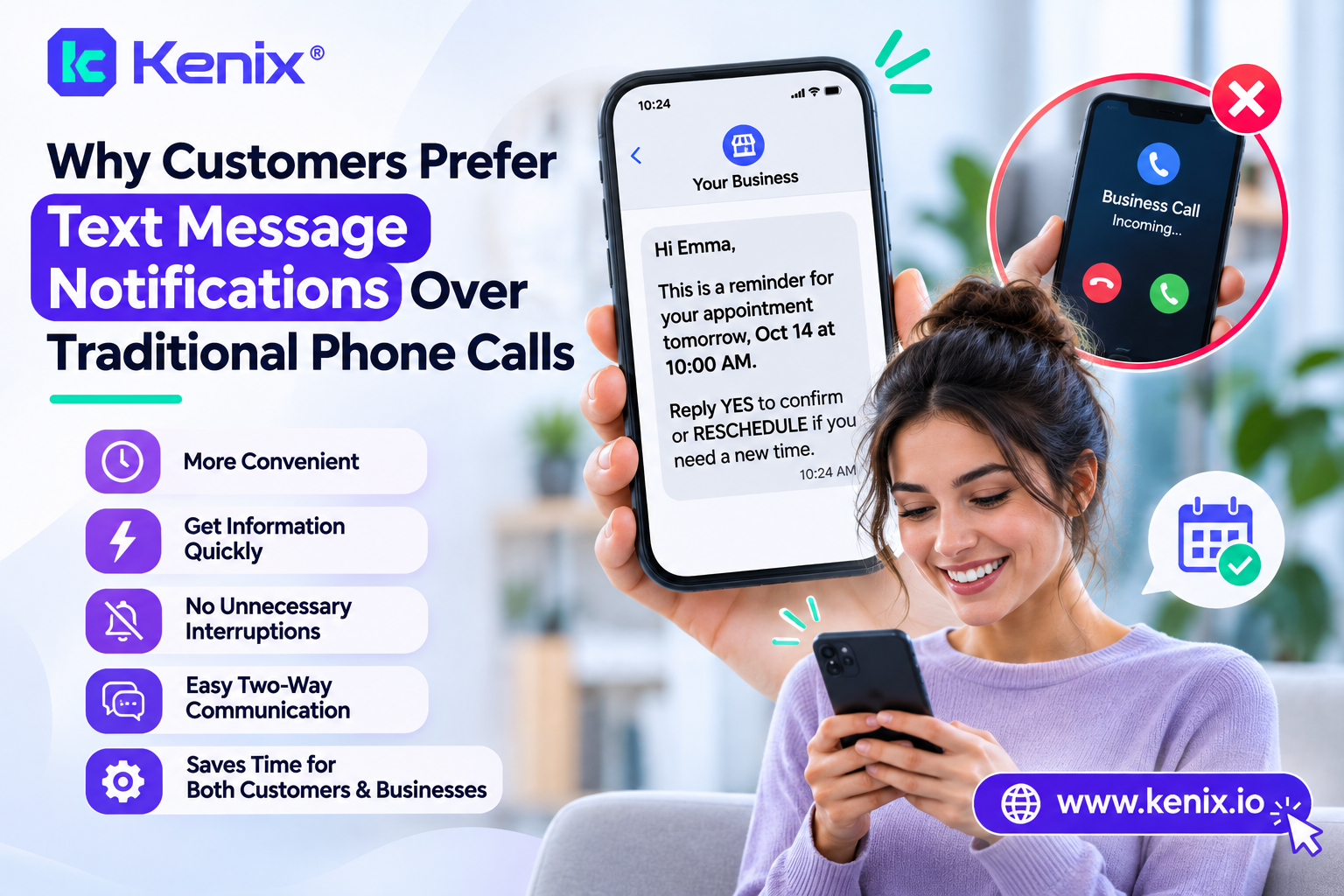
Customer communication has changed significantly over the past few years. People expect businesses to provide quick updates, convenient booking options, and timely notifications without interrupting their daily routines. While traditional phone calls remain useful for important conversations, text messaging has become a preferred communication method for many everyday interactions.
From appointment confirmations to payment updates, businesses increasingly use SMS notifications to keep customers informed. Text messages allow customers to access important information whenever they need it, without having to answer a call or spend time listening to voicemail messages.
This shift has encouraged businesses across healthcare, retail, hospitality, automotive services, and professional services to adopt automated messaging solutions. Understanding why customers prefer text-based communication can help businesses improve customer experience and build stronger relationships.
1. Text Messages Offer Greater Convenience
Convenience is one of the main reasons customers prefer text messages over traditional phone calls. People have busy schedules, and answering an unexpected call is not always possible.
A text message allows customers to read important information at a time that suits them. They can check a booking confirmation, review an appointment time, or save an address without needing to speak with a representative.
For example, a customer who books a dental appointment can receive a confirmation message containing the date, time, clinic address, and contact details.
With text appointment reminders, businesses can also help customers remember upcoming appointments without requiring them to answer repeated phone calls.
This makes communication easier for both customers and service providers.
2. Customers Can Access Information Quickly
Phone conversations require customers to listen carefully and remember important details. If they miss something, they may need to call the business again.
Text notifications provide information in a written format that customers can revisit whenever necessary.
For instance, a service business can send a message containing:
- Appointment date and time.
- Booking confirmation number.
- Location or address.
- Preparation instructions.
- Rescheduling information.
- Customer support contact details.
Having these details available in a message reduces confusion and makes it easier for customers to manage their schedules.
Businesses can also include relevant links to booking pages, payment portals, maps, or customer support resources.
3. Text Notifications Reduce Unnecessary Interruptions
Unexpected phone calls can interrupt meetings, work, travel, and personal activities. Even when customers recognise a business number, they may not be available to answer immediately.
Text messages provide a less disruptive alternative.
Customers can read notifications when they have time. They do not need to stop what they are doing or find a quiet place to answer a call.
This is particularly useful for appointment-based businesses that need to communicate regularly with customers.
For example, a salon can send an appointment reminder a day before a scheduled visit. The customer can review the message and confirm their availability without speaking to a receptionist.
This approach supports better communication while respecting customers’ time.
4. Two-Way Messaging Makes Communication Easier
Modern business messaging is no longer limited to sending one-way notifications. Many SMS platforms support two-way communication, allowing customers to respond directly to messages.
This feature makes everyday interactions more efficient.
For example, a customer receiving an appointment reminder may reply with a confirmation or request a different time. The business can then update the booking accordingly.
Two-way messaging can support several activities:
- Confirming upcoming appointments.
- Requesting appointment changes.
- Answering basic customer questions.
- Sharing additional booking information.
- Collecting customer feedback.
Businesses can also use automated responses to handle common requests and reduce the workload on customer support teams.
However, more complex enquiries may still require a direct phone conversation.
5. Written Notifications Reduce Communication Errors
Verbal communication can sometimes lead to misunderstandings. Customers may forget appointment timings, confuse dates, or miss important instructions during a phone conversation.
Text notifications provide a written record that customers can check later.
For example, a vehicle servicing company can send a confirmation message with the booking date, vehicle drop-off time, and service location.
Customers can refer to the message whenever they need the information.
This also helps businesses maintain more consistent communication. Automated messaging systems can use predefined templates to share accurate information across different customer interactions.
Businesses should ensure that their messaging systems update information correctly whenever a booking changes.
6. Automated Messaging Improves Business Efficiency
Managing customer communication manually can consume considerable time, particularly for businesses handling dozens or hundreds of appointments every week.
Staff members may need to make confirmation calls, follow up with customers, and respond to routine scheduling questions.
Automated SMS notifications can reduce much of this repetitive work.
Businesses can configure messages to be sent automatically when:
- A customer books an appointment.
- An appointment is approaching.
- A booking gets rescheduled.
- A payment is received.
- A service has been completed.
Automation helps businesses maintain consistent communication without requiring staff to send every notification manually.
It also allows employees to focus on customer enquiries and tasks that require personal attention.
7. Personalised Messages Improve Customer Engagement
Customers are more likely to value communication when it contains information relevant to their needs.
Personalised text notifications allow businesses to include details such as the customer’s name, appointment time, service type, and booking reference.
For example, instead of sending a generic reminder, a healthcare provider can send a message confirming the patient’s upcoming appointment with the relevant date and time.
Personalisation makes messages easier to understand and helps customers recognise that the notification relates to their specific booking.
However, businesses should avoid sending unnecessary messages or including sensitive personal information in ordinary SMS notifications.
Conclusion
Customer expectations continue to influence how businesses communicate. Convenience, accessibility, quick information sharing, and fewer interruptions have made text messaging an effective alternative to traditional phone calls for routine notifications.
From booking confirmations to text appointment reminders, SMS communication helps businesses keep customers informed while reducing repetitive administrative work.
Businesses that combine automated notifications with responsive customer support can create a more convenient communication experience. Choosing the right communication channel for each interaction is essential. Platforms like Kenix help businesses explore smarter communication and appointment management solutions, making it easier to manage customer interactions and deliver timely notifications.
