
Building a successful career in today’s competitive technology industry requires the right skills, practical knowledge, and professional guidance. As organisations increasingly depend on data-driven decisions, opportunities in Data Science and Artificial Intelligence are expanding across industries, including banking and financial services. For aspiring professionals, finding the best data science training institute can be an important first step towards achieving their career goals.
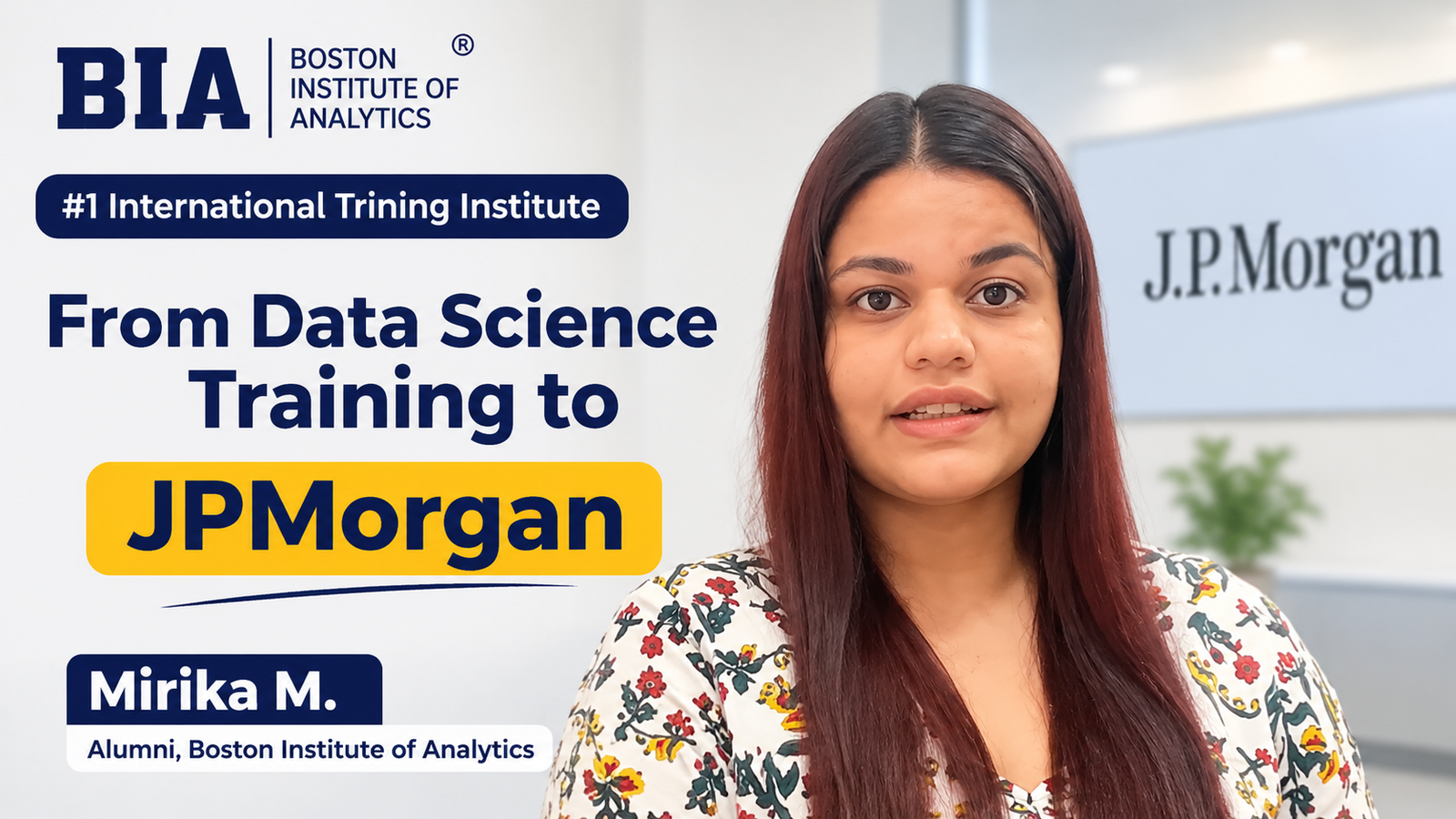
Among the options available, choosing the best data science course in bengaluru or another major technology hub means looking beyond classroom learning and considering practical exposure, expert mentorship, industry-oriented projects, and placement assistance. Mirika’s journey from learning Data Science and AI at Boston Institute of Analytics to achieving a career milestone at JPMorgan highlights how structured training and comprehensive career support can contribute to professional development.
Read More: From Student to Data Analyst: Shraddha’s Career Journey
Key Highlights of Mirika’s Career Journey
- Completed specialised Data Science and Artificial Intelligence training at Boston Institute of Analytics.
- Gained exposure to industry-relevant technical concepts and practical learning.
- Benefited from expert trainer guidance and mentorship.
- Developed knowledge of analytical tools and real-world applications.
- Received access to career preparation and placement support.
- Achieved an important professional milestone by joining JPMorgan.
1. Why Did Mirika Choose Data Science and Artificial Intelligence?
Data has become one of the most valuable resources for modern businesses. Organisations collect enormous amounts of information through customer interactions, financial transactions, digital platforms, and business operations. However, transforming this information into meaningful insights requires specialised technical knowledge.
Data Science and Artificial Intelligence help businesses understand patterns, predict outcomes, automate processes, and make informed decisions. These technologies are particularly important in financial services, where accuracy, security, and efficient decision-making are essential.
For individuals interested in technology-driven careers, learning data science provides an opportunity to explore multiple professional domains. From data analysis and machine learning to business intelligence and predictive modelling, the field offers several areas for specialisation.
Mirika’s association with the Data Science and AI programme at Boston Institute of Analytics reflects this growing interest in specialised technical education. Her subsequent achievement of joining JPMorgan makes her journey particularly relevant to students who aspire to build careers in the technology and financial services sectors.
2. How Boston Institute of Analytics Made Learning Data Science More Structured
Learning data science independently can be challenging because the subject combines programming, mathematics, statistics, databases, and machine learning. Without a structured learning approach, students may find it difficult to understand how these concepts connect with one another.
Boston Institute of Analytics provides a comprehensive Data Science and Artificial Intelligence programme designed to introduce learners to essential concepts before progressing towards advanced applications.
The learning pathway covers important subjects, including:
- Python programming and data analysis.
- SQL and database management.
- Statistics and mathematical foundations.
- Machine learning algorithms.
- Natural Language Processing.
- Data visualisation using Tableau and Power BI.
- Artificial Intelligence applications.
- Practical case studies and capstone projects.
This structured curriculum helps learners develop a foundation in technical subjects while understanding their applications in professional environments.
Instead of focusing only on theoretical explanations, the programme incorporates practical exercises and assignments that encourage students to apply their knowledge.
For aspiring professionals, having access to an organised curriculum, learning resources, and trainer guidance can make the educational experience more effective.
3. The Role of Expert Mentorship in Mirika’s Learning Journey
Technical subjects often become easier to understand when learners receive guidance from experienced instructors. Programming errors, statistical concepts, machine learning techniques, and analytical assignments can create challenges, particularly for beginners.
This is where mentorship becomes valuable.
Boston Institute of Analytics incorporates trainer-led learning and expert mentorship into its training approach. Industry-experienced trainers help students understand technical concepts, work through practical problems, and develop their analytical abilities.
Mentorship also supports learners beyond classroom explanations. Students can receive guidance while completing assignments, understanding project requirements, and improving their technical knowledge.
The institute’s learning support includes additional resources such as
- One-to-one mentorship.
- Extra weekday sessions for additional learning support.
- Recorded learning resources.
- Learning Management System (LMS) access.
- Practical assignments and case studies.
- Capstone project guidance.
These facilities create a more structured learning environment in which students can strengthen their understanding and work towards their professional goals.
4. How Practical Projects Help Students Develop Industry-Relevant Skills
One of the most important aspects of learning data science is understanding how technical concepts are used to solve real-world problems.
Knowing Python or machine learning terminology is not enough. Professionals must understand how to collect data, clean datasets, select suitable algorithms, evaluate results, and communicate insights.
Boston Institute of Analytics emphasises practical learning through assignments, case studies, and capstone projects.
For example, students may explore analytical problems involving customer behaviour, sales forecasting, financial trends, or predictive modelling. Such exercises introduce learners to the different stages of a data science workflow.
A typical project involves
- Understanding the problem statement.
- Collecting and exploring relevant datasets.
- Cleaning and preparing data.
- Applying suitable analytical techniques.
- Developing and evaluating predictive models.
- Interpreting results.
- Presenting findings through reports or dashboards.
These activities help learners develop problem-solving abilities and become familiar with the processes followed in professional analytical environments.
Boston Institute of Analytics also provides capstone project guidance, allowing learners to bring together different technical concepts and demonstrate their understanding through a practical project.
5. How Boston Institute of Analytics Supports Students Beyond Technical Training
A professional training programme should not end with completing the curriculum. Students also need guidance to prepare for interviews, present their technical abilities, and explore suitable career opportunities.
Boston Institute of Analytics provides career development resources through its placement assistance and Career Enhancement Cell (CEC).
The institute’s support covers several important areas.
ATS-Friendly Resume Development
A professional resume helps candidates present their technical knowledge, academic qualifications, projects, and relevant experience. Resume-building guidance helps learners organise their information and highlight important skills.
LinkedIn Profile Optimisation
An ATS-friendly resume helps candidates highlight their skills, qualifications and projects while improving compatibility with recruitment systems. A strong LinkedIn profile increases professional visibility, helps connect with recruiters and industry experts, and opens doors to potential job opportunities.
Technical Mock Interviews
Technical interviews often evaluate programming knowledge, analytical thinking, database concepts, and problem-solving abilities. Mock interviews help students practise answering technical questions.
HR Interview Preparation
Communication, confidence, and the ability to explain professional goals are important during recruitment. HR interview preparation helps learners become familiar with common interview discussions.
Career Counselling and Mentoring
Career guidance helps students understand different job roles, identify relevant opportunities, and prepare for their next professional steps.
Placement Assistance
Boston Institute of Analytics provides 100% lifetime placement assistance, helping learners access career guidance and recruitment-related support beyond the completion of their training.
These services make the institute’s approach more comprehensive by combining technical education with professional preparation.
6. Why Is JPMorgan an Important Career Milestone?
JPMorgan is a globally recognised financial services institution with extensive operations across banking, investment services, financial technology, and related business areas.
Modern financial institutions increasingly depend on technology and data analytics to support business decisions and improve operational efficiency.
Some important applications of data science in financial services include:
Fraud Detection: Analytical systems help identify unusual transaction patterns and potential fraudulent activities.
Risk Assessment: Data-driven models help financial organisations evaluate risks and support financial decision-making.
Customer Analytics: Businesses analyse customer information to understand preferences and improve service delivery.
Predictive Modelling: Historical data can be used to identify trends and develop forecasts.
Business Intelligence: Dashboards and analytical reports help organisations monitor performance and identify areas for improvement.
These applications demonstrate why data science knowledge is valuable in the financial services industry.
Mirika’s achievement of joining JPMorgan represents an important professional milestone and highlights the relevance of developing technical skills for opportunities in large corporate environments.
Her journey can encourage aspiring learners to explore the applications of Data Science and AI beyond conventional technology roles.
7. What Makes Boston Institute of Analytics a Considerable Choice for Data Science Training?
Choosing a training institute requires evaluating more than the subjects included in a course. Students should also consider practical exposure, trainer expertise, learning flexibility, mentorship, and career assistance.
Boston Institute of Analytics brings together several of these learning and career development elements.
Its Data Science and AI programme offers multiple learning pathways:
| Programme | Duration | Additional Practical Exposure |
| Certification | 4 months | Practical exercises and structured training |
| Diploma | 6 months | Guaranteed 2-month internship |
| Master Diploma / PG Master Diploma | 10 months | Guaranteed 6-month OJT as a Data Scientist |
The institute also offers classroom and interactive online learning options, recorded learning resources, and access to its Learning Management System (LMS), ensuring a flexible and structured educational experience.
Students gain exposure to industry-relevant technologies and practical applications through assignments, real-world case studies, capstone projects, and expert mentorship. The programme focuses on developing both technical expertise and professional skills required in today’s competitive job market.
Key learning and career development benefits at Boston Institute of Analytics include
- Industry-Experienced Trainers: Learn from experienced professionals with industry knowledge and practical insights.
- Comprehensive Curriculum: Develop knowledge from foundational concepts to advanced applications in Data Science and Artificial Intelligence.
- Practical Learning: Gain hands-on experience through assignments, industry-oriented case studies, and capstone projects.
- Dual Certification: Benefit from dual certification pathways that add value to professional learning.
- Flexible Learning Options: Access classroom training, interactive online sessions, and recorded learning resources.
- Career Counselling and Mentorship: Receive guidance to support career planning and professional development.
- Resume and LinkedIn Assistance: Build professional profiles and present technical skills effectively.
- Interview Preparation: Improve interview readiness through technical and HR mock interviews.
- 100% Placement Guarantee: Guaranteed placement opportunities with dedicated career support and interview preparation.
Beyond its training and career development initiatives, Boston Institute of Analytics takes pride in its alumni network, with former students working across leading global organisations. Its alumni have progressed into professional opportunities at companies such as IBM, Deloitte, Walmart, Microsoft, Intel, Google, Apple, Amazon, Infosys, Meta, and Capgemini.
These alumni achievements reflect the diverse career opportunities that learners can pursue across technology, consulting, financial services, retail, and other industries.
For individuals looking for a top data science training institute in bengaluru, Boston Institute of Analytics offers a comprehensive learning experience through industry-oriented education, practical training, expert mentorship, career assistance, and an accomplished alumni network with professionals working across leading global companies.
8. What Can Aspiring Data Science Professionals Learn from Mirika?
Every professional journey is different, but student success stories can provide useful insights for individuals planning their careers.
Mirika’s journey offers several important lessons.
Choose a structured learning pathway: Specialised training can help learners develop technical knowledge systematically.
Focus on practical understanding: Working with datasets and completing projects helps students understand how analytical concepts are applied.
Make use of mentorship: Guidance from experienced trainers can support learning and improve problem-solving abilities.
Develop professional skills: Technical knowledge should be supported by communication, presentation, and interview preparation.
Explore different industries: Data science is relevant to banking, healthcare, retail, technology, consulting, and several other sectors.
Continue learning: AI and data science technologies continue to evolve, making continuous skill development important.
Boston Institute of Analytics brings these elements together through its technical curriculum, mentorship, practical learning, and career assistance resources.
Mirika’s association with JPMorgan serves as an encouraging example for students who want to develop expertise in Data Science and Artificial Intelligence and explore opportunities in the corporate world.
9. Watch Mirika’s Data Science and AI Experience
A student’s learning experience is best understood through their own perspective. Mirika’s testimonial provides an opportunity to learn more about her association with Boston Institute of Analytics and her Data Science and AI learning journey.
Her experience highlights the importance of structured training, expert mentorship, and career development support.
Watch her testimonial here
Conclusion
Building a career in data science requires the right combination of technical knowledge, practical experience, mentorship, and professional preparation.
Mirika’s journey from Data Science and AI training at Boston Institute of Analytics to joining JPMorgan highlights the importance of a structured learning environment and comprehensive career support.
The institute provides students with an industry-oriented curriculum, practical assignments, capstone projects, experienced trainers, mentorship, and 100% lifetime placement assistance. Its additional career development resources help learners prepare for professional opportunities.
For students and working professionals interested in entering the analytics and technology industry, choosing the best data science training institute can be an important step towards developing relevant skills. With consistent learning, practical exposure, and the right guidance, aspiring professionals can work towards building rewarding careers in the evolving world of Data Science and Artificial Intelligence.
Frequently Asked Questions
1. Who is Mirika, and where did she get placed?
Mirika is associated with the Data Science and AI programme at Boston Institute of Analytics. She achieved an important career milestone by joining JPMorgan. Her student testimonial shares insights into her learning experience.
2. How did Boston Institute of Analytics support Mirika’s learning journey?
Boston Institute of Analytics offers structured technical training, industry-experienced trainers, expert mentorship, practical assignments, case studies, and capstone projects. The institute also provides career preparation resources to help students develop professional skills.
3. What does the Data Science and AI course at Boston Institute of Analytics cover?
The programme covers Python, SQL, statistics, machine learning, Natural Language Processing, data visualisation, and Artificial Intelligence applications. Students also receive practical exposure through assignments, case studies, and capstone projects.
4. What placement guarantee does Boston Institute of Analytics provide?
Boston Institute of Analytics offers a 100% placement guarantee, supported by ATS-friendly resume development, LinkedIn profile guidance, technical and HR mock interviews, career counselling, expert mentoring, and recruitment support through its Career Enhancement Cell (CEC).
5. Why should students choose the best data science training institute for their career?
A good training institute provides a structured curriculum, practical learning, experienced trainers, mentorship, industry-relevant projects, and career assistance. These elements help learners develop technical capabilities and prepare for professional opportunities in data science and AI.
