
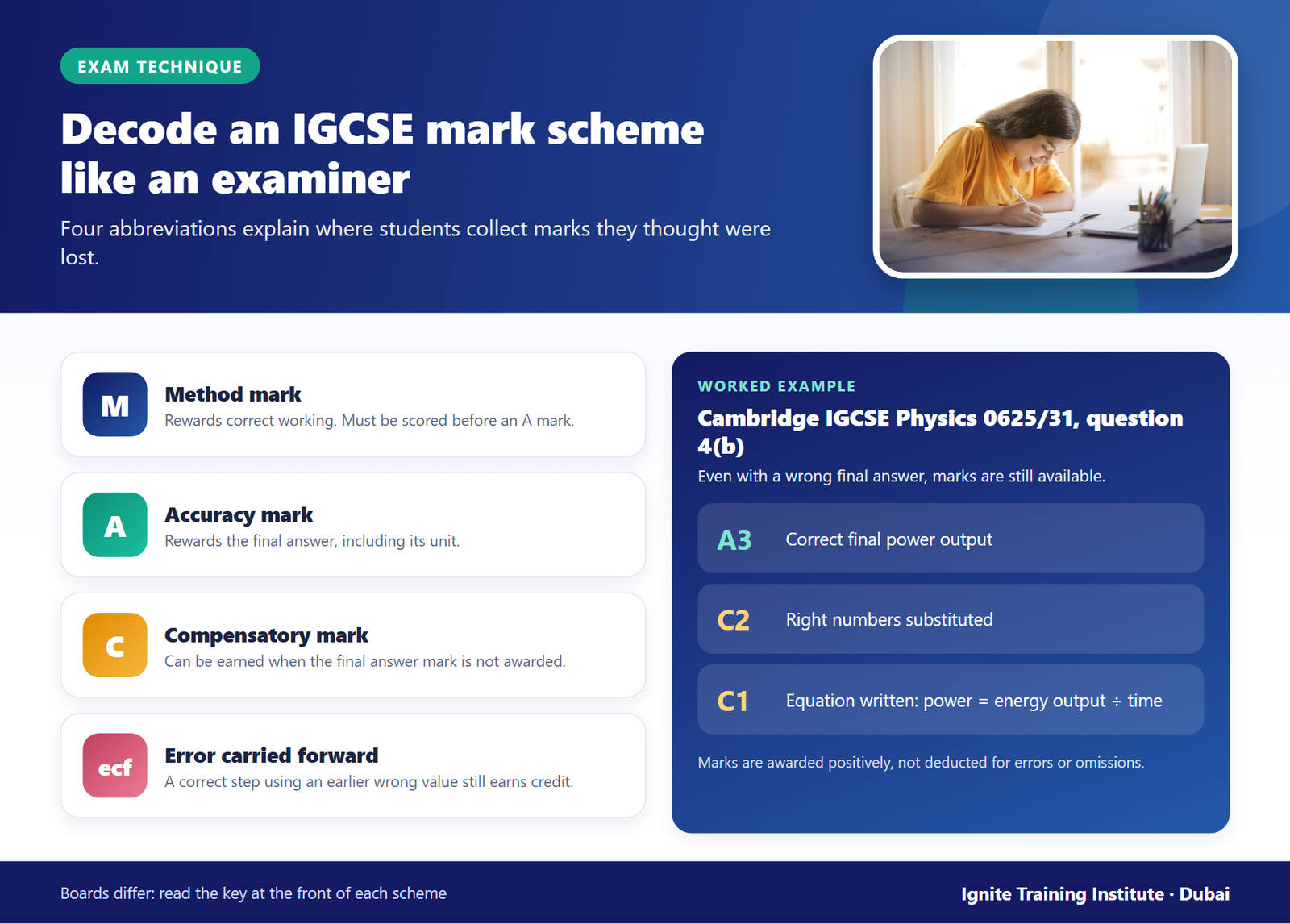
An IGCSE mark scheme shows exactly how examiners award marks, and students are allowed to read it. Dubai schools teach IGCSE-level courses from several boards, including Cambridge, Pearson Edexcel and OxfordAQA, and each board publishes its own schemes with its own conventions. The examples below come from one Cambridge paper, but the habits apply across subjects: find what earns a mark, then answer to that standard.
How IGCSE Mark Schemes Work
What a mark scheme actually tells a student
A mark scheme lists the points that earn marks and the rules examiners follow when awarding them. According to the Cambridge IGCSE Physics 0625/31 mark scheme (Paper 3 Core Theory, May/June 2023), marks are awarded positively and are not deducted for errors or omissions.
That changes how students should write. Question 3(b) in the same scheme lists six acceptable ideas under “any two from” and awards two marks. A student who finds two valid ideas has finished. The list is a menu, not a checklist.
Method marks, accuracy marks and “follow-through”: how they work
Method marks reward the working, accuracy marks reward the final answer, and follow-through protects later marks after an earlier slip. In the Physics scheme, an M mark is a method mark that must be scored before a final answer (A) mark. A C mark is compensatory: it can be earned when the final answer mark has not been awarded. The abbreviation “ecf” means error carried forward, so a correct step that uses an earlier wrong value still earns credit.
Question 4(b) shows the pattern. A correct final power output earns A3. Below it, substituting the right numbers earns C2, and writing the equation (power = energy output ÷ time) earns C1. A student with a wrong final answer can still collect marks for the right equation and the right substitution.
The same scheme gives full credit for a correct answer without working, unless the question says “show your working”. Many IGCSE exam tips say to always show working. The scheme shows when it is optional and when it is not. Other boards, including Pearson Edexcel and OxfordAQA, use their own conventions, so the key at the front of each scheme is worth reading first.
Reading command words the way an examiner does
A command word tells a student what kind of answer earns the marks. Cambridge’s published list of command words defines “explain” as setting out reasons or relationships, which includes the instruction to “say why and/or how and support with relevant evidence”. It treats “state” as expressing something in clear terms and “describe” as giving the main features.
Question 5(b) in the Physics scheme shows why this matters. It gives one mark for “pressure increases” and a second for the reason: “(as) more (frequent) collisions (with walls of box)”. A student who states the change and stops earns one mark out of two.
The habit that follows is simple. Underline the command word, then check the mark total. Two marks on an explain question often means two points: the change and the reason.
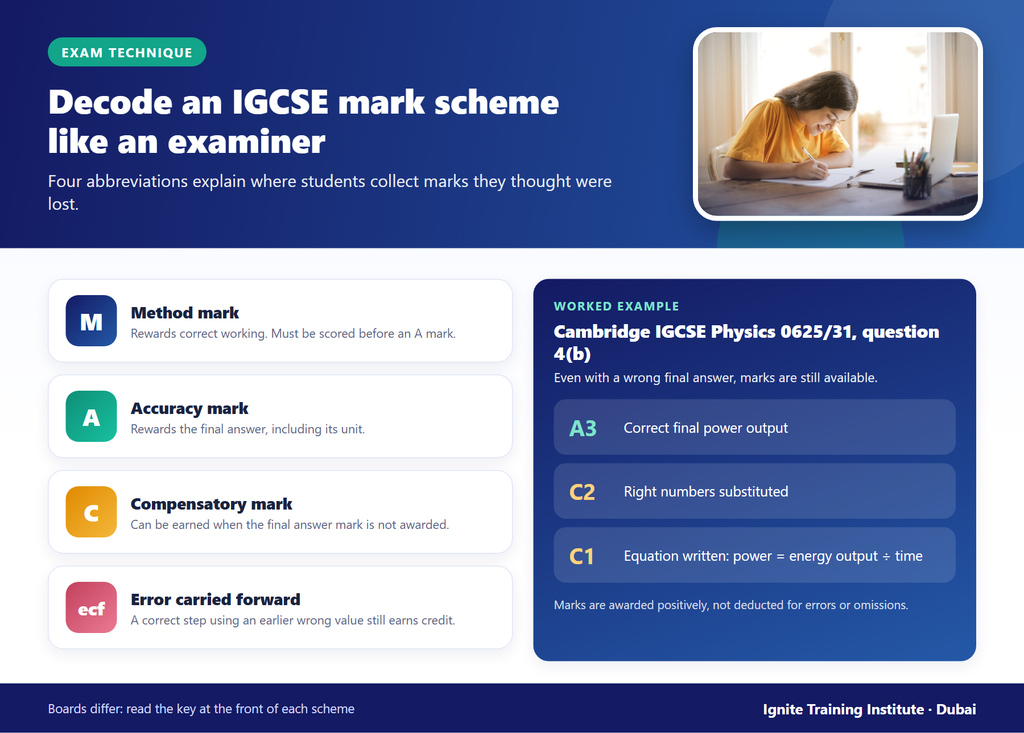
Infographic: how method, accuracy, compensatory and error-carried-forward marks work. Source: Ignite Training Institute.
Turning Mark Schemes Into Marks
Self-marking a past paper with the official IGCSE mark scheme
Students mark most accurately when they treat the scheme as the only authority. IGCSE past papers help only when the matching scheme from the same series sits beside them. A workable method:
- Attempt the paper under timed conditions, without notes.
- Mark it in a different colour, awarding only what the scheme credits.
- Write the reason beside every lost mark.
Wording matters less than students expect. The abbreviation “owtte” means “or words to that effect”. In question 2(c), the scheme credits “move (lifting) force further from pivot owtte”, so a different phrasing of the same idea can still earn the mark. Students should not mark themselves down for style, or up for vague answers.
Reviewing a marked paper with someone who knows the board speeds up the diagnosis. A subject teacher can do this, as can IGCSE tutors in Dubai at a centre such as Ignite Training Institute, which teaches IGCSE students online and in person.
Spotting the “easy marks” students lose most often
Four patterns appear in the Cambridge Physics scheme, and each one is avoidable:
- Missing units. An A mark needs a fully correct final answer including the unit, and a missing or incorrect unit normally costs the final calculation mark.
- Stopping at the name. Question 6(c) awards one mark for naming “refraction” and a second for “change of speed”.
- Over-listing. For questions such as “State two reasons”, the scheme reads the response as continuous prose. Incorrect responses still count towards the number asked, and contradictory statements cancel credit.
- Confusable terms. Spelling need not be perfect, but it must separate terms such as refraction and reflection.
The list rule catches many students. A student asked for two reasons who writes four, with a wrong idea among the first two, can lose a mark despite correct points later in the answer.
Turning mark-scheme patterns into a revision routine
A routine works when lost marks are sorted by type, not by topic. After marking three to five papers, students can tally losses under labels such as units, working, missing reason and misread command word, then drill the largest group first.
The scheme itself says it should be read alongside the question paper and the Principal Examiner Report for Teachers, so the matching examiner report, where the school can supply it, is the next document to read. A student whose log shows five missing reason marks needs practice on two-mark explanations, not another full read of the chapter. The routine works the same in class, at home or through IGCSE online tuition.
Key takeaway: A mark scheme is the examiner’s checklist made visible. Students who learn what each mark type rewards, what a command word demands and how the list rule works collect marks that knowledge alone does not secure. Boards differ, so the key at the front of each scheme should be read before any marking begins.
References
- Cambridge International. Physics 0625/31 mark scheme.
- Cambridge International. Command words list.
About the author
Sumit Advani writes about IGCSE education. As Co-Founder of Ignite Training Institute, a tutoring centre in Dubai, he brings over 10 years of education expertise in the UAE. With a B.Sc. in IT and a Diploma in Advertising & PR, he designs personalised academic programmes that help students achieve their goals.
