
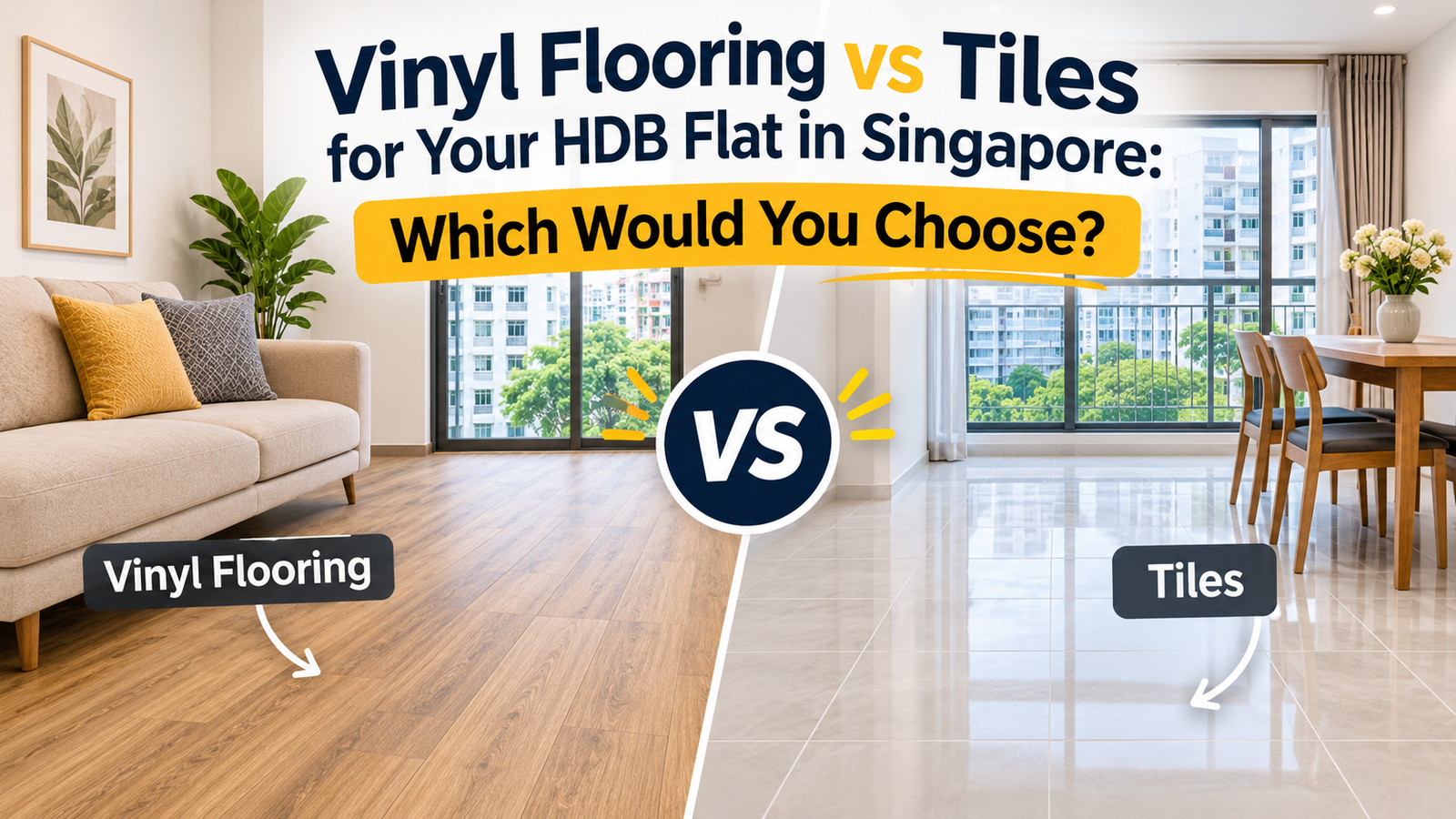
Most HDB flats come with tiles, often homogeneous tiles in the living areas. They are tough and easy to clean, but they can feel cold and hard, and they show their age after a decade or two. So when renovation time comes, the vinyl flooring vs tiles question comes up quickly: keep the tiles, replace them with new tiles, or lay vinyl flooring on top?
No single answer suits every flat. HDB’s rules, your budget and how you use each room all play a part. This guide walks through each factor and ends with a clear recommendation for each part of the flat.
What Is Vinyl Flooring, and How Is It Different From Tiles?
Vinyl flooring is a resilient floor covering made of bonded layers: a backing, a core, a printed design layer and a clear wear layer on top. Tiles are hard, fired slabs set in cement or adhesive. Vinyl feels softer and quieter underfoot, while tiles are harder and colder but extremely durable.
Most of what you see in the vinyl flooring Singapore market today is click-lock luxury vinyl tile (LVT) or rigid-core SPC. The planks lock together and “float” over the floor below, so they need no cement.
Homogeneous tiles are a type of porcelain tile with the same colour running through the whole tile. That’s why they hide chips well and last a long time. Ceramic tiles have a glazed surface over a clay body and are common in older flats and wet areas.
For a closer look at the layers, thicknesses, and types, this guide on vinyl flooring explains how each one performs at home.
Do You Need an HDB Permit for Vinyl Flooring or New Tiles?
Under HDB’s building works guidelines, you do not need a permit to lay vinyl flooring. You do need one to replace existing floor finishes such as homogeneous or ceramic tiles. The total thickness of the new floor finishes and screed must then stay within 50mm. This is the biggest practical difference between the two options.
Here is a simple summary of the rules on HDB’s building works guidelines page:
| Work in an HDB flat | Permit needed? | Key condition |
| Laying vinyl, carpet or linoleum | No | None listed |
| Replacing tiles (homogeneous, ceramic, marble and others) | Yes | Floor finishes plus screed must not exceed 50mm |
| Replacing bathroom floor finishes in the first 3 years of the block | Not allowed | Permit required after 3 years |
If you plan to hack tiles, your contractor must also follow HDB’s rules on noisy work. The Ministry of National Development states that noisy renovation such as hacking and drilling is limited to 9 am–5 pm on weekdays, excluding public holidays.
How Do Vinyl Flooring and Tiles Compare in an HDB Flat?
Vinyl wins on renovation speed, comfort and noise, because it goes over existing tiles without hacking. Tiles win on water resistance in wet areas and long-term hardness. Vinyl also tends to cost less overall, mainly because it avoids hacking and disposal.
| Factor | Vinyl flooring | New tiles |
| Renovation work | Laid over existing tiles; no hacking | Hacking, screeding and curing |
| Disruption | Quiet and fast; often a day or two for an average flat | Several days of noisy work |
| Feel underfoot | Warmer, softer, quieter | Cool and hard |
| Water | Waterproof planks, but the joints are not sealed | Excellent, especially over waterproofing |
| Durability | Depends on the wear layer; can dent under heavy loads | Very hard-wearing; can crack or pop |
| Repairs | Replace individual planks | Matching old tiles can be difficult |
| Cost (supply and install) | About S$5 – S$11 per sq ft, laid over existing tiles with no hacking | About S$12 – S$18 per sq ft for homogeneous tiles, plus roughly S$4 – S$11 per sq ft for hacking and disposal |
Because vinyl can usually be laid straight over existing tiles, HDB owners skip the hacking and disposal costs, which is often where most of the savings come from.
Noise matters more in HDB living than many people expect. Vinyl, especially with a built-in underlay, softens footsteps and dropped items, which neighbours downstairs will appreciate.
Which Floor Works Best in Each Part of an HDB Flat?
Use vinyl in the dry living spaces and keep tiles in the wet areas. Living rooms, bedrooms and studies benefit most from vinyl’s comfort. Bathrooms and service yards are better left tiled, especially in a new BTO flat.
- Living and dining areas: vinyl, for a warmer feel and a seamless look across rooms.
- Bedrooms and study: vinyl, for quieter, softer floors.
- Kitchen: both can work. Vinyl handles everyday spills, but wipe up water quickly and keep it away from areas that are often wet.
- Bathrooms: tiles. For BTO flats, HDB’s MyNiceHome renovation guide explains that you need a permit to change bathroom finishes after the first 3 years.
- Service yard and balcony: tiles, because these areas are exposed to water.
When Should You Keep Your Existing Tiles?
Keep your tiles if they are in good condition, you like the look, and your budget is tight. Tiles in good shape will last for decades. If you only want a fresh look, a deep clean and regrout may be enough.
Keeping tiles also makes sense if you plan to sell soon, or if a room is often wet. However, fix hollow, cracked, or loose tiles first, whether you keep them or lay vinyl over them. A floor is only as stable as what lies beneath it.
So, Vinyl or Tiles: Which Should You Choose?
For most HDB flats, the most practical mix is vinyl in the living room, bedrooms and study, with tiles kept in the bathrooms and service yard. This avoids hacking, keeps renovation short, makes the home quieter and leaves waterproofing intact where it matters most.
Replacing tiles throughout only makes sense if the existing floor is badly damaged, too uneven to level, or the owner strongly prefers a cool, hard surface. For most households, vinyl in the dry areas offers the best balance of comfort, cost and convenience.
Before You Decide: A Quick Checklist
- Check your current tiles for hollow or cracked spots.
- Measure door and cabinet clearances, since a new layer adds height.
- Confirm whether your flat is still within the 3-year BTO period.
- Compare wear layer thickness and warranty, not just price.
- Ask for samples and view them in your own lighting.
Where to Get Vinyl Flooring for an HDB Flat in Singapore
If vinyl sounds like the right fit for your flat, work with a supplier that handles both the product and the installation. Xin Furnishing, a direct vinyl flooring supplier in Singapore, offers wood, stone and microcement-look vinyl for HDB, BTO, and condo homes. Its team can check whether your existing tiles are suitable for an overlay before work begins. You can also view samples in person at the showroom before deciding.
Xin Furnishing (Singapore)
🌐 Website: https://xinfurnishing.sg/
📞 Phone: +65 9376 6998 | +65 9690 2060
📍 Location: 101 Woodlands Avenue 12, #04-32, Singapore 737719
